
Bike Shelters Nottingham – Secure Cycle Storage & Weather Protection
Bespoke Bicycle Storage Solutions - Wall-mounted, freestanding, enclosed designs
Bike Shelters Nottingham
Quality bicycles represent significant investments that deteriorate rapidly when stored outdoors without proper protection. Weather exposure degrades components, rust attacks chains and gears, and theft or vandalism remain constant concerns. Purpose-built bike shelters address these problems by providing weather protection and security appropriate to your circumstances, whether that's a simple covered area for two family bikes or a fully enclosed lockable structure for valuable road bikes or commercial cycle parking.
We fabricate bike shelters ranging from compact wall-mounted designs for single bikes to substantial freestanding structures accommodating 10+ bicycles for schools, workplaces, or apartment complexes. Steel framework provides robust construction that withstands all-weather exposure and resists tampering, whilst roof designs shed water away from bikes and allow adequate ventilation preventing moisture buildup that accelerates corrosion.
Why Invest in Proper Bike Storage
Protecting Bikes from Weather Damage
Bicycles stored outdoors without overhead protection suffer accelerated wear from multiple weather-related factors. Rain penetrates bearings, cables, and gear mechanisms, causing corrosion that compromises performance and safety. UV radiation degrades rubber components – tyres, grips, brake pads – causing perishing and cracking. Temperature cycling causes condensation inside frame tubes and components, promoting internal rust that remains invisible until structural damage occurs.
Even bikes stored under simple tarpaulins or against walls receive inadequate protection. Tarpaulins trap moisture against bike frames rather than allowing air circulation, often accelerating corrosion. Wind-driven rain reaches bikes positioned against walls, and tarps themselves degrade in UV exposure, typically failing within 1-2 years and requiring replacement.
Purpose-built bike shelters with proper roof overhangs keep rain off bikes whilst allowing airflow that prevents moisture accumulation. This combination – overhead protection with adequate ventilation – dramatically extends component life and maintains bike value far more effectively than improvised storage solutions.
Security Considerations
Bicycle theft affects thousands of UK households annually, with valuable bikes representing attractive targets for opportunistic thieves. Bikes stored visibly in gardens, driveways, or communal areas face higher theft risk than bikes stored in dedicated secure structures that require more effort and time to breach.
Security requirements vary considerably based on bike value, location crime rates, and whether bikes remain unattended for extended periods. A basic shelter for family bikes in a securely fenced garden might need only simple locking mechanisms, whilst commercial cycle parking requires robust construction, secure ground anchoring, and lockable enclosures preventing quick snatch-and-grab theft.
We design bike shelters incorporating appropriate security measures for your circumstances – from internal locking points allowing bikes to be secured to shelter frameworks, to fully enclosed lockable structures with reinforced doors and concealed hinges that resist forced entry. This graduated approach ensures you invest appropriately in security without over-engineering domestic storage or under-protecting valuable equipment.
Bike Shelter Design Types
Open Shelters with Roof Protection
Open bike shelters provide overhead weather protection whilst maintaining simple construction and straightforward bike access. Steel framework supports roof panels – typically corrugated plastic, polycarbonate, or metal sheeting – that shed rainwater whilst allowing light transmission and maintaining visual openness. Side panels may be absent entirely or included on one or two sides to provide additional weather protection from prevailing wind and rain directions.
These designs suit locations with existing security – enclosed gardens, gated yards, or monitored commercial premises – where weather protection matters more than preventing theft. Bikes remain visible, which deters opportunistic theft whilst avoiding the enclosed feeling of fully covered structures. Open shelters also excel in terms of ventilation, eliminating moisture accumulation concerns that affect enclosed designs.
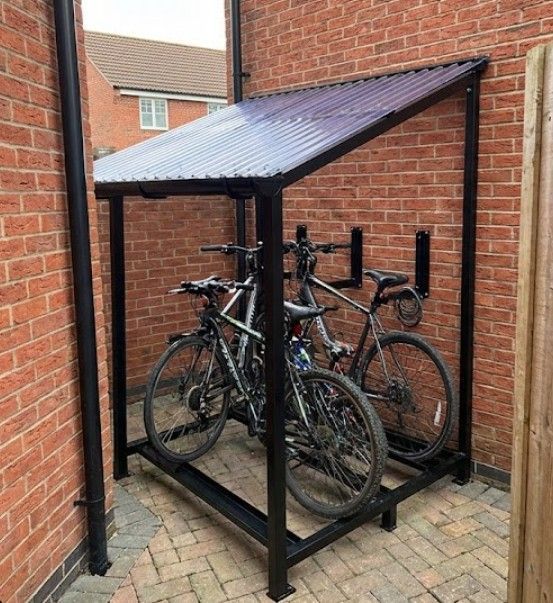
Wall-mounted open shelters minimise ground footprint by fixing directly to property walls, with angled roof panels projecting outward to cover bikes leaned against the wall below. These compact designs accommodate 1-3 bikes in minimal space, ideal for terraced properties or locations where ground area is at a premium. The wall provides one side of the structure, reducing materials and construction complexity whilst maintaining effective weather protection.
Fully Enclosed Lockable Shelters
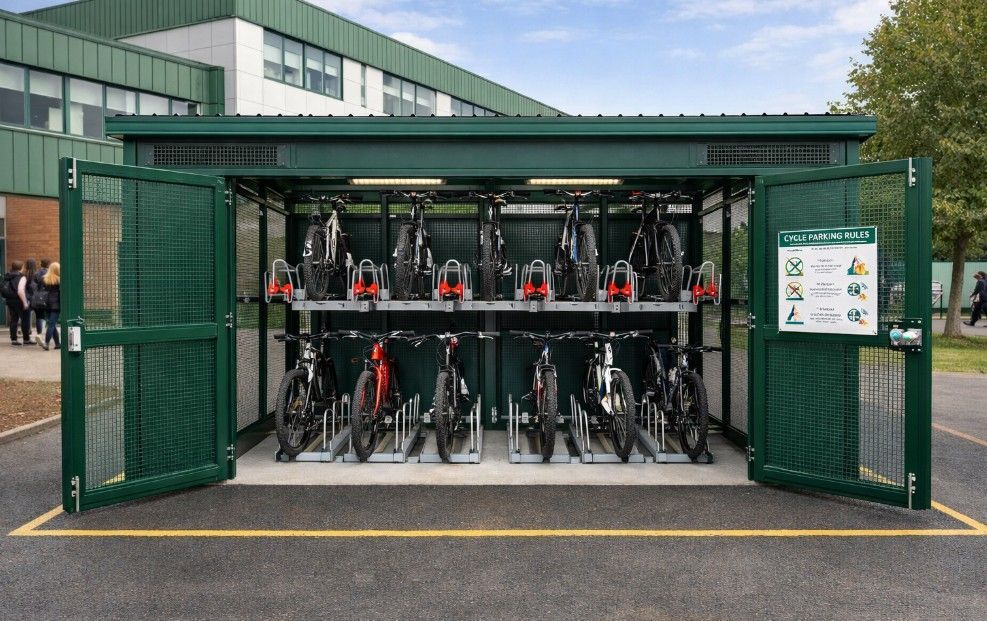
Enclosed bike shelters function essentially as bike sheds, providing complete protection from weather and security against theft. Steel framework supports solid or mesh panel walls and lockable doors, creating secure storage accessed only by authorised users. These designs suit locations where bikes remain unattended regularly – workplaces, schools, apartment complexes – or where bike values justify investment in comprehensive security.
Door designs vary from simple hinged single doors for compact shelters to double doors or sliding panels on larger structures accommodating multiple bikes. Lockable mechanisms range from padlock hasps for basic security to heavy-duty commercial locks, keypad entry systems, or even proximity card access for commercial installations requiring user tracking.
Enclosed shelters require careful attention to ventilation despite being fully covered. Bikes brought inside while wet from rain or after winter riding carry moisture that evaporates inside enclosed spaces. Without adequate ventilation, this moisture condenses on bike frames and components overnight, potentially causing more corrosion than open storage. We incorporate ventilation grilles, gaps between roof and walls, or louvred panels that maintain airflow whilst preserving security and weather protection.
Lean-To and Wall-Mounted Designs
Lean-to bike shelters fix against existing walls or buildings, creating covered storage using the building as one side of the structure. This approach reduces construction costs and ground footprint whilst providing substantial weather protection. Lean-to designs work particularly well against garden walls, garage sides, or property boundaries where adequate wall space exists and bike storage against the wall makes practical sense.
The angled roof typically slopes away from the wall, shedding water outward. Guttering can be incorporated to manage runoff, directing water into existing drainage systems rather than creating puddles alongside the shelter. These designs accommodate varying numbers of bikes depending on wall length – compact 2m lean-tos handle 2-3 bikes comfortably, whilst longer runs can create covered parking for 6-8+ bikes.
Wall-mounted racks that hold bikes vertically or horizontally represent the most space-efficient storage option, though these provide no weather protection unless positioned under existing overhangs or combined with canopy structures. We fabricate wall-mounted systems where maximising bike capacity in limited space takes priority over weather protection, typically for covered locations or where bikes are moved indoors during extended periods.
Material Options and Construction Methods
Metal Framework with Timber or Composite Cladding
Steel framework combined with timber or composite panel cladding creates bike shelters that complement garden settings whilst delivering structural integrity necessary for weather protection and security. The framework provides fixing points for roofs, doors, and internal bike supports, whilst panel materials create walls, screening, or decorative elements appropriate to your property aesthetics.
Timber cladding offers traditional appearance and can match existing garden furniture or fencing. Vertical or horizontal boarding creates solid walls for enclosed shelters, or slatted panels can provide partial screening whilst maintaining visibility and airflow. Pressure-treated timber requires periodic treatment to maintain weather protection, but this maintenance burden remains modest given the aesthetic benefits timber brings.
Composite materials eliminate maintenance requirements whilst providing wood-like appearance. These panels resist moisture, won't rot or split, and maintain appearance despite prolonged weather exposure. For bike shelters that might receive minimal attention, composite cladding proves particularly effective – the structure continues looking professional year after year without requiring annual treatment that timber demands.
Powder-Coated Steel and Mesh Panels
All-metal bike shelters using powder-coated steel construction provide maximum durability and security. Solid steel panels create completely enclosed storage suitable for high-security applications, whilst perforated steel or welded mesh panels maintain visibility and ventilation where appropriate. These designs excel in commercial settings – workplaces, schools, public spaces – where robust construction resists vandalism and weather exposure without requiring ongoing maintenance.
Powder coating in colours matching property exteriors or existing structures helps metal shelters integrate visually despite industrial-strength construction. Dark colours (anthracite, black, dark green) prove particularly effective at disguising security features and making substantial structures less visually prominent.
Mesh panels balance security with visibility – preventing theft whilst allowing supervision of enclosed cycle parking areas. This visibility deters misuse and helps users feel comfortable accessing shelters after dark, important considerations for commercial cycle parking in workplace or educational settings.
Roof Materials and Weather Protection
Roof material selection affects both shelter performance and aesthetics. Corrugated polycarbonate sheets provide excellent weather protection whilst allowing light transmission, preventing enclosed shelters feeling dark and claustrophobic. These lightweight panels integrate easily with steel framework and prove cost-effective for most applications.
Clear or translucent panels maintain brightness, whilst tinted options reduce solar heat gain during summer whilst still transmitting adequate light. Polycarbonate resists UV degradation and impact damage far better than traditional corrugated PVC, typically lasting 10-15+ years before requiring replacement.
Metal roof panels – typically powder-coated steel or aluminium – provide more substantial appearance and longer service life, though at higher cost. These suit larger commercial shelters or designs where roof aesthetics matter significantly. Metal roofs can incorporate insulation where thermal performance matters, though this rarely proves necessary for cycle storage.
Roof overhangs extending beyond shelter sides prevent wind-driven rain reaching bikes, particularly important for open-sided designs. Overhangs of 0115 647 6611mm prove effective for most locations, with larger overhangs in exposed sites where prevailing winds frequently drive rain horizontally.
Sizing Bike Shelters for Different Capacities
Space Requirements Per Bike
Standard adult bicycles require approximately 600mm width when stored upright side-by-side, though 0115 647 6611mm spacing provides more comfortable access and prevents handlebar interference between adjacent bikes. Depth requirements vary by bike type – standard bikes need approximately 1800mm, whilst bikes with child seats, panniers, or racing configurations may require 2000mm+ to avoid protruding beyond shelter edges.
Height clearances depend on storage method. Bikes on ground-mounted stands typically require 0115 647 6611mm clearance to handlebar height, whilst bikes stored on wall-mounted hanging systems need 0115 647 6611mm to accommodate wheels oriented vertically. Roof height should exceed maximum bike height by 0115 647 6611mm to provide comfortable access and avoid banging bikes against roof structures.
Compact Shelters for 1-3 Bikes
Small household bike shelters accommodate 1-3 bikes in structures approximately 0115 647 6611mm wide and 0115 647 6611mm deep. These dimensions allow bikes to be stored side-by-side with adequate space for manoeuvring bikes in and out without complex choreography. Wall-mounted or lean-to designs can reduce footprint further by eliminating one structural side.
For terraced properties or locations with severe space constraints, vertical storage systems holding bikes in wall-mounted racks reduce ground footprint dramatically – a vertical bike storage system might measure only 600mm wide × 600mm deep whilst accommodating 2-3 bikes. However, these systems require users comfortable lifting bikes to hang them, which may not suit all household members or heavy bikes.
Medium Shelters for 4-8 Bikes
Family cycle storage or small workplace parking requires structures approximately 0115 647 6611mm wide accommodating 4-8 bikes depending on internal layout. These shelters often incorporate Sheffield stands or wheel channels that maintain bikes upright and organised, preventing the tangled handlebar situations that occur when multiple bikes simply lean against walls.
Medium shelters benefit from double-door access – opening both doors creates wide access making bike parking and retrieval straightforward even when the shelter is nearly full. Single doors on wider shelters create awkward access to bikes positioned far from the entrance, discouraging users from utilising full shelter capacity.
At this scale, internal organisation becomes important. Alternating handlebar directions allows tighter spacing – one bike's handlebars positioned over the adjacent bike's rear wheel rather than handlebars clashing. Some users prefer defined spaces for each bike, whilst others want flexible parking. We can incorporate both approaches depending on your priorities.
Large Commercial Installations for 10+ Bikes
Commercial cycle parking – schools, workplaces, apartment complexes, public facilities – requires shelters accommodating 10, 20, or more bikes with clear organisation and adequate capacity for peak usage times. These installations often use two-tier storage systems maximising bikes per square metre, or long single-tier arrangements with well-defined spaces preventing access conflicts during busy periods.
Large shelters frequently incorporate multiple access points preventing bottlenecks when many users arrive or depart simultaneously. Wide central aisles allow bike movement without requiring users to squeeze between parked bikes. Signage indicating spaces or numbering positions helps maintain organisation in commercial settings where users may not know each other.
These installations require robust ground anchoring resisting high wind loads on large roof areas, and framework designed for regular heavy use. Commercial-grade components – industrial hinges, substantial locks, reinforced door frames – prevent premature failure from intensive daily use by many users.
Internal Bike Support Systems
Sheffield Stands and Wheel Channels
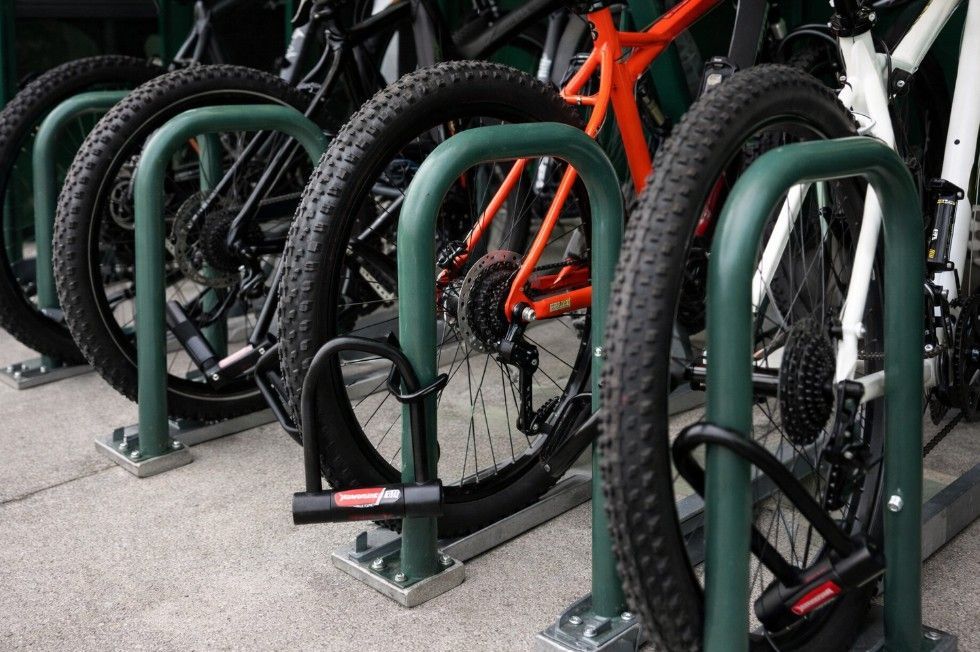
Sheffield stands – the inverted U-shaped supports familiar from public cycle parking – provide excellent bike support and locking points within shelters. Bikes lean against stands which hold front wheels securely, whilst U-lock or cable lock passes through frame and stand preventing theft. We fabricate and install Sheffield stands appropriate to your shelter design, spacing them adequately to prevent handlebar interference.
Wheel channels – metal rails positioned on shelter floors that hold bike wheels upright – offer alternative support particularly effective for narrow shelters where Sheffield stands might create awkward spacing. Channels maintain bikes in organised rows and prevent domino-effect falls when bikes are parked or retrieved.
Both systems benefit from secure ground fixing preventing unauthorised removal. We typically set supports in concrete footings or bolt through shelter floors into substantial foundations, ensuring supports resist attempted removal and provide secure attachment points for bike locks.
Wall-Mounted Hanging Systems
Wall-mounted systems that lift bikes off the ground maximise shelter capacity by storing bikes vertically or horizontally along walls. These systems suit shelters where floor space is premium or where segregating bikes by user preference matters – children's bikes on lower mounts, adult bikes higher, cargo bikes in designated larger spaces.
Horizontal wall mounts typically support bikes by front wheel, lifting the bike so rear wheel hangs clear of ground. These prove straightforward to use for most cyclists and work well for standard bikes. Vertical mounts rotating bikes 90° to hang vertically save even more space but require more effort to mount and dismount bikes, potentially unsuitable for heavy bikes or less physically able users.
We design wall-mounted systems with adequate spacing between mount points preventing bikes interfering when stored. Weight capacity matters – mounts must support fully-loaded touring bikes or heavy electric bikes without deforming or pulling free from walls.
Two-Tier Storage Systems
Two-tier systems stack bikes vertically, with upper-tier bikes lifted using gas-strut or counterweight mechanisms making vertical storage manageable even for heavy bikes. These systems effectively double cycle parking capacity within the same footprint, critical for commercial applications where site area constrains cycle parking provision.
Upper-tier operation requires clear instruction signage and sometimes user familiarisation to ensure comfortable use. Well-designed systems make upper-tier parking straightforward through proper counterweighting or gas-strut assistance, but poorly designed systems frustrate users and result in upper tiers remaining empty despite lower-tier capacity being exceeded.
Two-tier systems suit commercial installations where maximising bike capacity justifies higher complexity and cost. Domestic applications rarely benefit from two-tier storage unless space constraints are extreme and household members are comfortable operating mechanical systems.
Security Features and Locking Options
Residential Security Requirements
Domestic bike storage typically requires security deterring opportunistic theft whilst remaining convenient for daily use. Internal locking points – loops, Sheffield stands, or dedicated mounting brackets – allow bikes to be secured to shelter structure using D-locks or cable locks. This prevents simple bike theft whilst avoiding heavy-duty security measures that complicate legitimate access.
Where shelters include doors or access panels, simple padlock hasps provide adequate security for most residential locations. Combination locks eliminate key management whilst providing reasonable security. For higher-value bikes, heavy-duty padlocks and reinforced hasps increase security without requiring expensive commercial-grade hardware.
Positioning shelters within view of property windows or in areas with natural surveillance improves security significantly. Thieves avoid locations where they might be observed, making visible shelter positioning often more effective than purely relying on physical security measures.
Commercial and High-Security Applications
Workplace, educational, and public cycle parking requires robust security resisting determined theft attempts and vandalism. Heavy-duty door frames, concealed hinges preventing removal, and commercial-grade locks provide baseline security appropriate for these settings. Access control systems – keypads, proximity cards, or smartphone apps – eliminate physical key distribution whilst providing usage tracking.
Secure ground anchoring prevents entire shelters being dismantled or tipped to access bikes. We set commercial shelters on substantial foundations with below-ground fixing points that resist extraction attempts. Framework joints use security bolts or welded construction preventing disassembly without specialised tools.
Lighting integrated into or positioned near cycle shelters improves security and user confidence, particularly important where bikes are accessed after dark. Motion-activated or dusk-to-dawn LED lighting proves cost-effective and maintenance-free, eliminating concerns about users accessing poorly-lit enclosed spaces.
Surveillance and Access Control
CCTV coverage of cycle parking areas deters theft and provides evidence if incidents occur. We can design shelter positioning considering camera placement and visibility, ensuring recorded footage captures clear views of access points and bike storage areas. This often requires coordinating shelter design with existing security systems during planning stages.
Access control beyond simple locks – electronic keypads, proximity card readers, or biometric systems – suits organisations needing user tracking or where key management becomes burdensome. These systems integrate with building security, allowing staff or student passes providing shelter access without distributing separate keys.
Audit trails showing when individual users accessed shelters help organisations monitor usage patterns, identify capacity requirements, and investigate incidents. This functionality justifies higher costs for commercial installations but proves unnecessary overkill for domestic applications.
Integration with Existing Structures
Matching Property Aesthetics
Bike shelters often sit visible from properties or public spaces, making visual integration important for maintaining overall aesthetic quality. Where properties feature existing metalwork – gates, railings, or outdoor furniture – matching powder coating colours and design details creates cohesive appearance rather than mismatched additions.
Timber cladding can match fencing, garden furniture timber species, or architectural details on buildings. This attention to material coordination makes bike storage feel intentional rather than afterthought additions, improving overall property appearance despite introducing utilitarian structures.
For commercial premises, bike shelters matching building colours, architectural style, or existing site furniture maintains professional appearance. Shelters positioned at building entrances become part of first impressions, making quality design and coordination with existing structures particularly important.
Planning Permission Considerations
Most domestic bike shelters under 2.5m high positioned behind the property frontage fall within permitted development rights requiring no planning permission. However, conservation areas, listed buildings, or prominent frontage locations may require planning approval even for modest structures.
Commercial cycle parking sometimes requires planning permission, particularly for substantial shelters or installations affecting car parking provision. Local planning policies increasingly encourage cycle parking provision, making planning applications for appropriately designed shelters generally straightforward even in locations with restrictive policies for other development types.
Where planning approval is required, bespoke designs specified to match existing materials and architectural character typically fare better than standard commercial shelters. We can provide drawings and specifications supporting planning applications, explaining design rationale and demonstrating consideration for surrounding context.
Maintenance and Long-Term Care
Framework and Structural Maintenance
Powder-coated steel framework requires minimal attention beyond periodic inspection and cleaning. Annual inspection checking for coating damage, particularly around ground-level components and high-wear areas like door hinges, allows addressing minor issues before they develop into corrosion problems. Touch-up paint for powder coating is available from automotive suppliers, making small repairs straightforward.
Bolt connections should be checked annually, retightening any that have loosened through thermal cycling or vibration. This simple maintenance prevents rattles developing and maintains structural integrity. Stainless steel bolts rarely require replacement, but standard steel fixings may eventually corrode and benefit from proactive replacement.
Ground-level components should be kept clear of vegetation and soil buildup. Plants growing against powder coating hold moisture causing premature paint failure, whilst soil accumulation against steel framework creates corrosion conditions. Occasional clearing around shelter bases prevents these issues with minimal effort.
Door and Lock Maintenance
Hinges, locks, and moving parts benefit from annual lubrication maintaining smooth operation. Graphite-based lubricants prove effective for locks, avoiding the dust accumulation that oil-based products cause. Hinges and gas struts require appropriate lubricants maintaining operation across temperature ranges without becoming sticky during cold weather.
Locks exposed to weather benefit from periodic cleaning removing salt and grime that can cause internal mechanism seizure. Covering keyhole openings when not in use – using flip covers or similar – extends lock life significantly in exposed locations. Commercial-grade locks typically prove more weather-resistant than domestic hardware, justifying higher costs for installations seeing frequent use.
Adjusting doors remains important – hinges can settle over time, causing doors to bind or not latch properly. These adjustments require only basic tools and ensure doors continue operating smoothly rather than becoming increasingly difficult to use as misalignment worsens.
Roof and Weatherproofing
Roof panels should be cleared of leaf buildup and debris several times annually, preventing drainage blockage and avoiding degradation of roofing materials buried under decomposing vegetation. This particularly matters for translucent polycarbonate panels where blocked gutters can cause water pooling that stresses panels and allows algae growth reducing light transmission.
Checking roof fixings ensures panels remain secure during high winds. Lost or damaged fixing screws should be replaced promptly rather than allowing panels to work loose. Replacement fixings should use appropriate washers and sealing grommets maintaining weathertight installation.
Polycarbonate panels typically last 10-15+ years before UV degradation causes brittleness requiring replacement. Metal roof panels last considerably longer but may require inspection for coating damage, particularly along cut edges where powder coating might have broken down allowing rust to develop.
Installation and Ground Preparation
Site Assessment and Foundation Design
Effective bike shelter installation begins with assessing ground conditions, checking for underground services, and determining appropriate foundation types. Shelters require substantial foundations resisting wind uplift on roof structures and maintaining stability despite daily use by multiple users potentially causing rocking forces.
Ground conditions vary dramatically – some locations offer firm ground suitable for direct post anchoring, whilst soft or waterlogged ground requires more substantial foundations. We assess these factors during site visits, recommending foundation designs appropriate to your ground conditions and shelter specification.
Existing hard surfaces – concrete, tarmac, paving – can often accommodate shelters using surface-mounted expanding bolt fixings, avoiding groundwork entirely. This proves particularly cost-effective and allows shelters to be relocated if circumstances change, though in-ground foundations generally provide superior stability for larger structures.
Drainage and Water Management
Positioning shelters requires considering water runoff from roofs and preventing puddles forming inside shelter areas or immediately outside access points. We design roof pitches shedding water away from main access routes, with guttering options directing runoff into existing drainage systems or soakaways.
Raising shelter floor levels slightly or installing with slight slope prevents water pooling inside covered areas. This matters particularly for enclosed shelters where water entering through doors or condensation from wet bikes needs to drain rather than accumulating. Perforated floors or gaps between floor panels allow drainage whilst maintaining covered storage.
Some locations benefit from surrounding drainage – French drains or gravel areas around shelter perimeters that manage runoff from roof areas whilst preventing muddy ground developing around shelter access points during wet weather.
Typical Installation Timeline
Straightforward bike shelter installations typically complete within 1-2 days depending on shelter size and ground conditions. Day one often involves foundation work – excavating and setting posts in concrete or preparing bases for surface-mounted designs. Framework installation, roof fitting, and door hanging typically complete on day two once foundations have cured sufficiently.
Complex installations requiring substantial groundwork, coordinating with existing structures, or integrating electrical services for lighting or access control may require 3-5 days. We provide realistic timescales during quotation, factoring in concrete curing times and any external dependencies affecting installation scheduling.
Bespoke Bike Storage in Nottingham
Ready to discuss your bicycle storage requirements?
Contact Nottingham Metalworks to discuss a bespoke bike shelter for your property. We provide detailed quotations following site visits, ensuring bike storage os fabricated precisely for your space, accessrequirements, and aesthetic preferences.
Call: 0115 647 6611
