Steel Building Frames Nottingham
Portal Frame Buildings, Moment Frames & Structural Steel Frameworks for Commercial & Industrial Construction
Steel Frame Fabrication
Nottingham Metalworks fabricates steel building frames for commercial, industrial, and agricultural projects across Nottingham and Nottinghamshire. From clear-span portal frames to multi-storey moment frames, we deliver complete structural steel frame solutions meeting BS EN 1090 standards with professional fabrication and installation services.
Professional Steel Frame Construction
Steel building frames provide efficient, economical structural solutions for warehouses, industrial facilities, agricultural buildings, commercial developments, and institutional structures. Frame construction offers clear-spanning space, rapid erection, design flexibility, and proven long-term durability that makes steel the preferred choice for most single-storey and many multi-storey buildings.
At Nottingham Metalworks, we specialise in fabricating and erecting steel building frames across Nottingham and Nottinghamshire. Our steel frame services cover portal frames for single-storey buildings, moment frames for multi-storey structures, braced frames for industrial facilities, and hybrid frame systems combining different structural approaches. Every frame is fabricated to BS EN 1090 structural steelwork standards, ensuring regulatory compliance and structural integrity.
Portal frames suit most single-storey buildings—warehouses, industrial units, retail sheds, agricultural buildings, sports facilities, and leisure centres. The structural efficiency of portal frames achieves clear spans up to 40+ metres without intermediate columns, maximising usable floor space. Pitched or curved rafter profiles accommodate various roof geometries whilst maintaining structural economy.
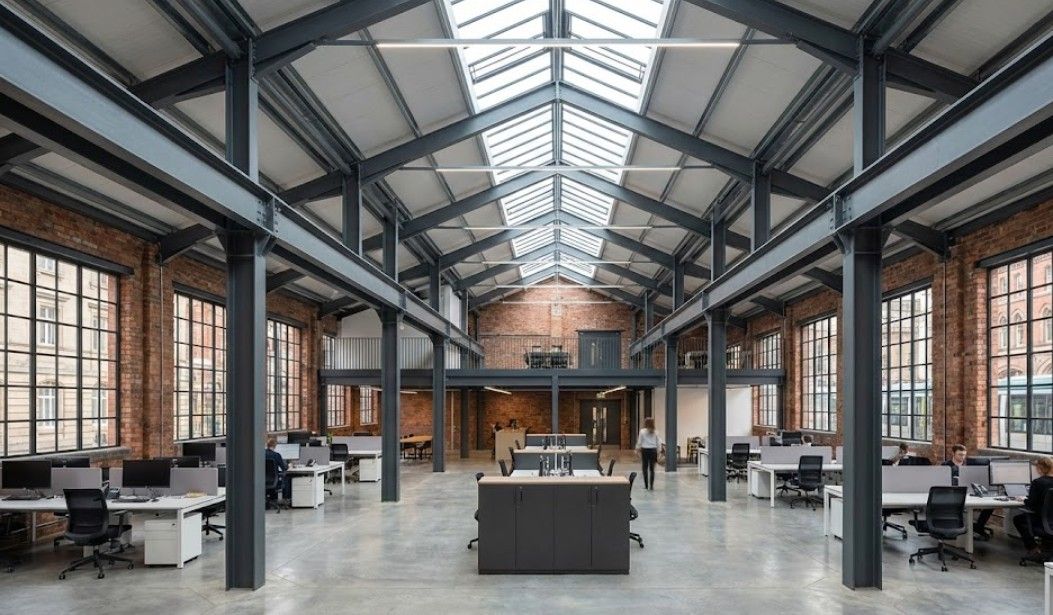
Moment frames provide column-free flexibility for multi-storey buildings where internal layout needs change over building life. Office buildings, car parks, residential developments, and mixed-use structures benefit from moment frame construction's adaptability. Frame bays align with planning grids, whilst structural depth is minimised to maximise floor-to-ceiling heights.
We work with structural engineers, architects, main contractors, developers, and building owners across diverse sectors—manufacturing and distribution, agriculture and food production, retail and commercial, leisure and sports facilities, and residential and mixed-use developments. Our frame fabrication integrates with modern building methods, supporting fast-track construction programmes and demanding project timelines.
TYPES OF STEEL BUILDING FRAMES
Portal Frame Structures
Standard Portal Frames
Portal frames consist of columns and rafters forming rigid frame bays that span building width. The column-to-rafter connection (the eaves haunch) creates the structural rigidity allowing portal frames to achieve substantial clear spans efficiently. We fabricate pitched portal frames with traditional roof profiles, mono-pitch portals for lean-to structures and modern aesthetics, curved rafter portals creating striking architectural forms, and tied portal frames incorporating tension ties for specific applications. Portal spacing (bay centres) typically ranges from 5-8 metres depending on cladding systems and roof loads.
Agricultural Building Frames
Agricultural structures require robust frames withstanding machinery impacts, livestock loads, and often aggressive internal environments. We fabricate portal frames for livestock housing with appropriate corrosion protection, grain stores and agricultural storage buildings, covered yards and implement sheds, equestrian facilities and stable blocks, and farm workshops and maintenance buildings. Agricultural frames often incorporate large door openings for machinery access, requiring structural coordination ensuring frame stability despite significant openings.
Industrial & Warehouse Frames
Commercial and industrial buildings demand frames accommodating heavy roof loads (plant equipment, suspended loads), supporting crane systems where required, providing clear internal height for storage or manufacturing, and allowing flexibility for service penetrations and building modifications. We fabricate frames for logistics warehouses and distribution centres, manufacturing facilities and production halls, retail warehouses and trade counters, and vehicle workshops and maintenance facilities.
Multi-Storey Frames
Moment Frame Structures
Multi-storey buildings benefit from moment frame construction where rigid beam-column connections resist lateral loads without diagonal bracing. We fabricate moment frames for office buildings requiring flexible internal layouts, car park structures with regular column grids, mixed-use developments combining different building functions, and residential developments where internal planning flexibility matters. Moment frames typically use UC (Universal Column) sections for vertical members and UB (Universal Beam) sections for horizontal members, with moment connections achieving through bolted end-plates or welded connections.
Braced Frame Systems
Where diagonal bracing is acceptable, braced frames provide economical multi-storey structures. We fabricate braced frames for industrial buildings where bracing doesn't impede operations, car parks where X-bracing or K-bracing suits the function, stair cores and lift shafts providing lateral stability, and buildings where architectural expression embraces visible bracing. Braced frames use simpler connections than moment frames, typically achieving construction economy whilst providing excellent lateral stability.
FRAME FABRICATION & ENGINEERING
Precision Steel Frame Manufacturing
Design Coordination
Steel frame fabrication begins with structural engineer's drawings showing frame geometry, member sizes, connection details, and loading specifications. We review designs identifying fabrication considerations, coordinating with engineers where clarification needed, and developing workshop fabrication drawings showing exact dimensions, hole positions, weld details, and assembly sequences. Early coordination ensures designs are practical to fabricate and erect whilst meeting structural performance requirements.
Component Fabrication
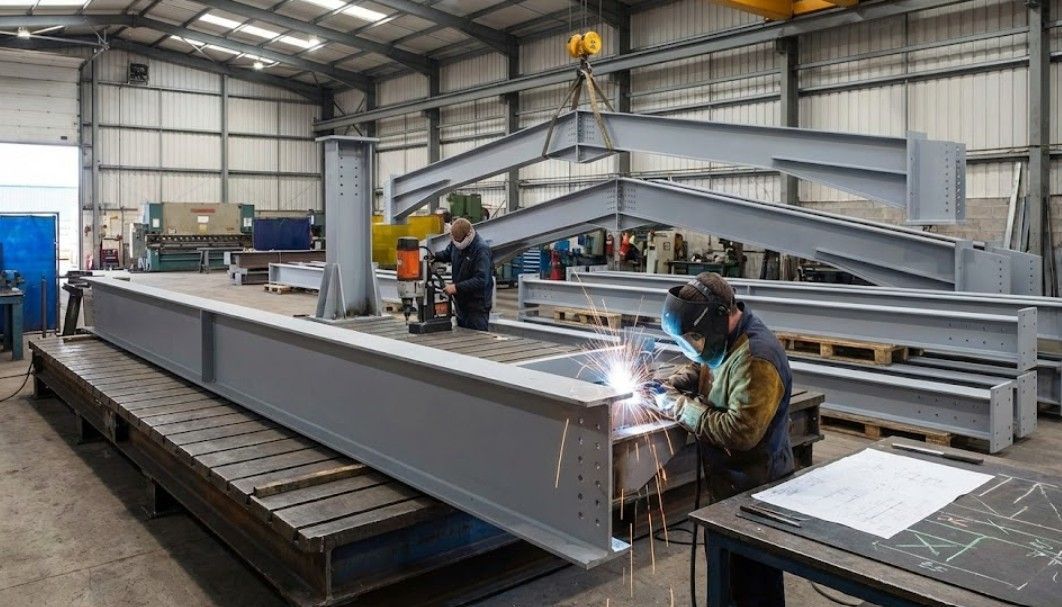
Frame members are fabricated in our workshop under controlled conditions. Columns are cut to length, base plates welded and drilled for foundation bolts, and splice plates prepared if required. Rafters receive haunch sections welded at specific angles and locations, apex connections fabricated for ridge joints, and purlin cleats fitted for secondary steelwork. All cutting, drilling, and welding follows BS EN 1090 procedures ensuring structural quality and dimensional accuracy.
Connection Engineering
Portal frame connections require particular attention. Eaves haunches transfer moments from rafters to columns efficiently—haunch geometry and welding must meet structural requirements. Apex connections join opposing rafters at ridge, typically using bolted or welded splices. Column bases transfer frame loads to foundations through base plates, holding-down bolts, and grouting. Connection fabrication accuracy directly affects site erection speed and structural performance.
Surface Preparation & Protection
Fabricated frames receive blast cleaning removing mill scale and contaminants, followed by protective primer coating. For agricultural buildings or aggressive environments, hot-dip galvanizing provides superior corrosion protection. Some projects specify intumescent coatings for fire protection. We coordinate finishing requirements during fabrication, ensuring frames arrive on site properly protected.
FRAME ERECTION & INSTALLATION
Professional Steel Frame Installation
Steel frame erection requires careful planning, appropriate equipment, and experienced installation teams. Our erection process ensures safe, efficient frame installation coordinated with foundation contractors and following building trades.
Site Preparation & Foundations
Frame erection depends on accurate foundations. Column base plates must align with holding-down bolts cast into concrete foundations—typically within ±3mm tolerance. We verify foundation positions before frame delivery, identifying any corrections needed before erection begins. This verification prevents costly delays and ensures frames erect smoothly.
Frame Erection Sequence
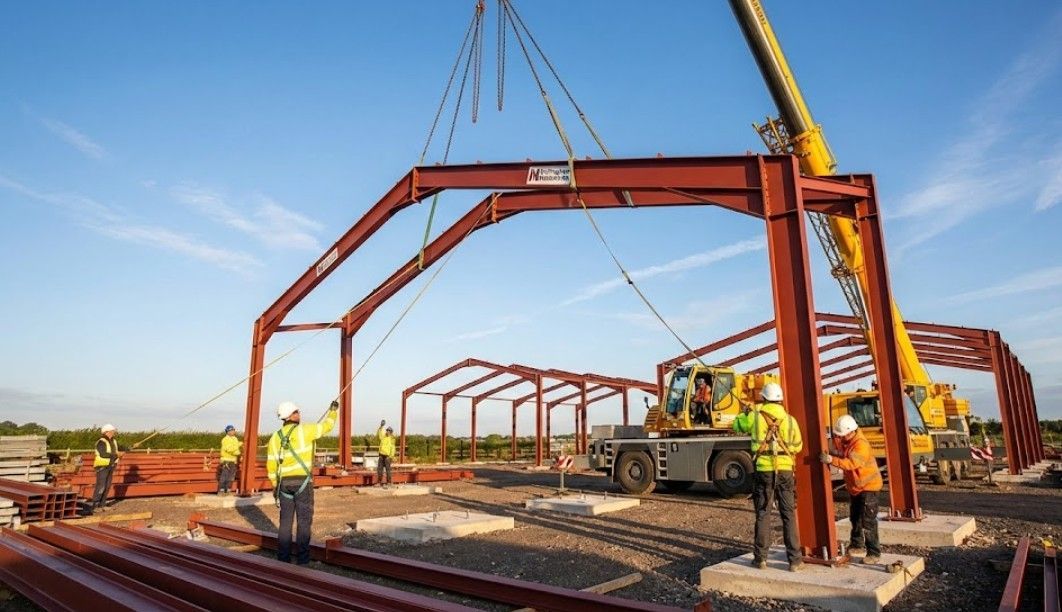
Portal frames typically erect in complete bay sections—both columns and connecting rafter lifted as a single assembly. Mobile cranes position frames onto holding-down bolts, steel erectors guide frames ensuring accurate vertical alignment, temporary bracing stabilises frames during erection, and bolted or welded connections join adjacent frames. Erection progresses bay-by-bay across building length until primary structure is complete.
Secondary Steelwork
Once primary frames are erected and braced, secondary steelwork provides roof and wall support. Purlins span between frames supporting roof cladding, side rails provide wall cladding support, and bracing systems resist lateral loads and ensure structural stability. Secondary steelwork installation completes the structural skeleton, ready for cladding contractors.
Quality & Safety
Frame erection follows comprehensive safety planning. Risk assessments address working at height, crane operations, and site coordination. Erectors use appropriate personal protective equipment, work platforms, and safety harnesses. Completed frames undergo dimensional verification confirming verticality, alignment, and connection integrity before hand-over to following trades.
WHY CHOOSE STEEL FRAMES
Benefits of Steel Frame Construction
Steel frames offer numerous advantages making them the default choice for most commercial and industrial buildings. Clear spanning eliminates internal columns, maximising usable floor space and operational flexibility. Design flexibility accommodates diverse building uses and future modifications. Rapid erection accelerates overall construction programmes, reducing financing costs and enabling earlier building occupation.
Steel's high strength-to-weight ratio reduces foundation loads compared to alternative structural materials. Off-site fabrication ensures consistent quality and weather-independent production. And steel's inherent durability provides decades of maintenance-free structural service, with frames regularly lasting 50+ years.
For agricultural buildings, portal frames represent the most economical construction method per square metre, achieving large clear-span spaces suited to modern agricultural operations. For commercial and industrial facilities, steel frames provide proven performance with extensive design experience and established construction methodologies.
COMMISSIONING YOUR STEEL BUILDING FRAME
Starting Your Frame Project
Commissioning steel building frames begins with discussing your building requirements—intended use, required floor area, clear span needed, height requirements, and any specific loading (storage racks, suspended loads, crane systems). We coordinate with structural engineers developing economical frame solutions, or if you have structural designs already, we fabricate to those specifications.
We provide detailed quotations covering frame design coordination if required, workshop fabrication of all frame components, protective coatings and corrosion protection, delivery to site, and professional erection and installation. Quotations clearly itemise each element, ensuring transparency and enabling informed decisions.
Steel frame fabrication typically requires 4 weeks from approved drawings to delivery. We coordinate schedules with your construction programme, ensuring frame delivery and erection aligns with foundation completion and doesn't delay following trades.
Steel Building Frames in Nottingham
Ready to discuss your building frame requirements?
Call: 0115 647 6611
Serving Nottingham, Nottinghamshire, and the East Midlands. Steel portal frames and moment frames for commercial, industrial, and agricultural buildings. Explore our structural steel services including steel beams and columns.
