
Bin Storage Nottingham - Custom Metal Wheelie Bin Stores
Bespoke Wheelie Bin Storage Solutions - Metal Frames with Timber or Composite Panels
Wheelie Bin Shelters Nottingham
Wheelie bins are necessary but rarely attractive, yet many properties struggle with inadequate space to screen them properly. Purpose-built bin storage solves this problem by keeping refuse and recycling containers out of sight whilst remaining easily accessible on collection days. We fabricate custom bin stores sized precisely for your wheelie bin configuration and the available space, creating practical storage that manages bins efficiently without compromising garden or frontage aesthetics.
Our bin storage designs combine steel framework with slatted or solid panel infill, creating robust structures that withstand daily use and all-weather exposure whilst allowing the airflow necessary to prevent odour buildup. Whether you need a compact two-bin store tucked against a boundary wall or a larger enclosure managing multiple recycling streams for a family home, we design and build bin storage addressing your specific requirements and spatial constraints.
Why Bespoke Bin Storage Makes Sense
Screening Bins Without Sacrificing Access
The fundamental challenge with bin storage is balancing screening from view with practical access. Bins must be wheeled out regularly, lids opened for waste disposal, and the storage area kept reasonably clean. Ready-made bin stores rarely fit available spaces perfectly and often compromise on either screening effectiveness or accessibility.
Custom fabrication creates bin stores fitted to your exact space – whether that's a narrow side passage, an awkward corner, or a frontage where planning restrictions limit positioning options. We design access gates or lift-off panels that make wheeling bins out straightforward, whilst ensuring the structure screens bins completely when closed. This attention to both aesthetics and practicality produces bin storage you'll actually use rather than abandon because it's too awkward.
Managing Multiple Bins Efficiently
Most households now manage multiple wheelie bins – general waste, recycling, garden waste, and often food waste caddies too. Storing 3-4 bins neatly whilst keeping each accessible requires more than simply screening them from view. Our bin stores incorporate adequate spacing between bins for comfortable lid opening, whilst maintaining compact external dimensions that don't consume excessive garden or driveway space.
We can design stores with dividers separating different waste streams, making it easier for household members to use the correct bins. Labelling positions on slatted panels or solid infill helps maintain organisation, whilst elevated floors keep bins off ground contact – reducing the moisture and corrosion that shortens bin lifespan and makes storage areas unpleasant to clean.
Bin Store Design Options
Open-Front Stores with Slatted Panels
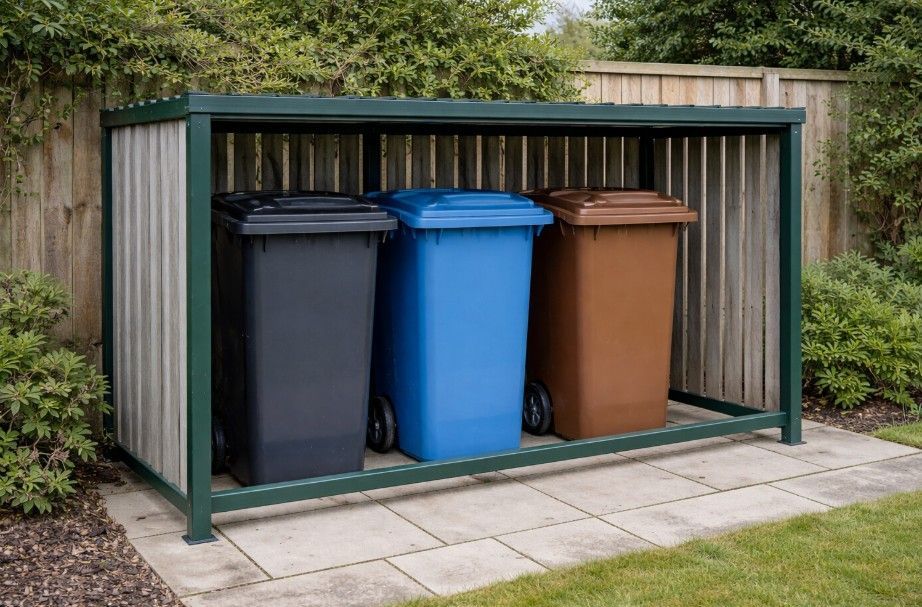
Open-front bin stores use slatted timber or composite panels across sides and rear, with the front remaining open or fitted with a simple gate. This design provides screening from most viewing angles – particularly important where bins sit visible from neighbouring properties or public footpaths – whilst allowing maximum airflow through the structure.
Slatted designs work especially well for bin storage because ventilation prevents odour accumulation between collection days. The gaps between slats allow air circulation whilst still screening bin bodies from view. Steel framework holds slats securely, and the open structure means rainwater drains through rather than pooling inside the enclosure.
These stores suit locations where bins sit against walls or fences, with the open front facing toward property access. A simple hinged gate or removable bar across the front prevents bins rolling out whilst keeping access quick and easy on collection day.
Fully Enclosed Stores with Hinged Lids
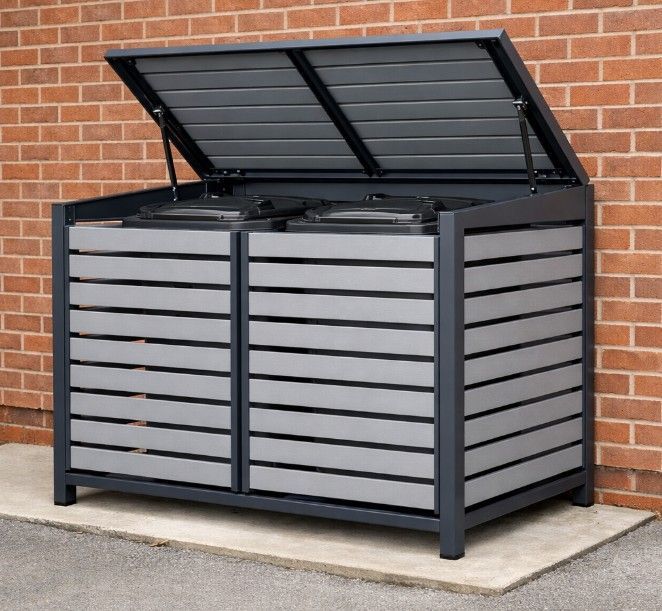
Fully enclosed bin stores screen wheelie bins completely, incorporating hinged lids that keep rain off bins and deter animals from accessing refuse. This design suits front gardens or visible locations where aesthetic considerations outweigh the simplicity of open-front designs, and where planning requirements may restrict what storage can be installed.
Hinged lids typically use gas struts for controlled opening and closing, preventing lids slamming shut and making large lids manageable for all household members. We incorporate locking mechanisms where security matters – preventing bins being wheeled away or deterring antisocial behaviour in areas where vandalism is a concern.
Fully enclosed stores require more substantial construction than open designs, but deliver complete screening and weather protection. Front panels can be split horizontally, with lower sections opening independently for daily waste disposal whilst keeping lids closed, or configured as full-width gates that open entirely on collection days.
Wall-Mounted and Space-Saving Designs
Properties with limited ground space – terraced houses with narrow frontages, flats with shared bin areas, or gardens where every square metre matters – benefit from wall-mounted bin storage or ultra-compact designs that maximise available space.
Wall-mounted stores fix directly to property walls, eliminating one side of the structure and reducing overall footprint. These designs work particularly well for single or two-bin configurations where adequate wall space exists. The wall provides structural support, allowing lighter framework construction whilst maintaining stability.
For side passages or tight corners, we fabricate stores as narrow as 800mm wide that accommodate two standard wheelie bins side-by-side with minimal clearance. These compact designs require careful measurement and often benefit from sliding rather than hinged access to avoid gates obstructing narrow passages when open.
Material Choices for Different Applications
Metal Framework with Timber Slatting
Steel framework with treated timber slatting creates bin stores that sit comfortably in garden settings, complementing existing fencing or outdoor furniture. The timber provides traditional aesthetics whilst the steel framework ensures structural integrity and secure ground fixing that keeps the store stable despite regular use.
We typically use pressure-treated softwood for economy or hardwood species for enhanced durability and richer appearance. Timber requires periodic treatment – usually annually – to maintain weather protection, but this maintenance burden is modest compared to the improved aesthetics timber brings. Slatting can be oriented horizontally or vertically depending on your preference and the screening effectiveness required from different viewing angles.
Metal Framework with Composite Panels
Composite materials – wood-plastic composites that combine wood fibres with polymer resins – deliver the appearance of timber without the maintenance requirements. Composite panels won't warp, split, rot, or require annual treatment, making them ideal for bin stores that might otherwise receive minimal attention.
These materials prove particularly effective for bin storage because they resist the moisture and occasional spills associated with refuse containers. Composite panels clean easily, maintain appearance despite prolonged weather exposure, and eliminate the wood rot that eventually destroys all-timber bin stores in ground-contact applications.
Initial costs are higher than timber, but longevity and reduced maintenance often make composite panels more economical over a bin store's lifespan. The consistent appearance – composites don't weather to grey like untreated timber – maintains visual quality year after year with virtually no attention.
Powder-Coated Steel Panels
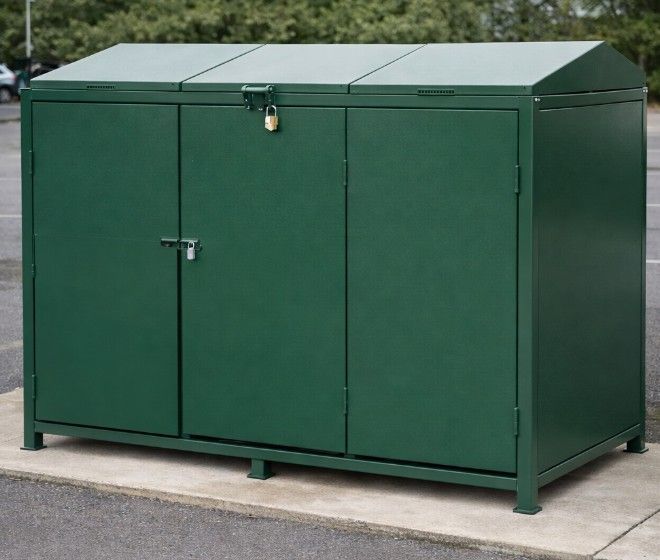
All-metal bin stores using powder-coated steel panels provide maximum durability and security. These designs suit commercial premises, apartment complexes, or residential properties where vandalism or security concerns justify more robust construction.
Steel panels can be solid for complete screening or perforated for ventilation, and powder coating in colours matching property exteriors helps metal stores blend into their surroundings. These stores tolerate rough treatment that would damage timber or composite alternatives, and any damage that does occur is typically repairable by refinishing rather than requiring panel replacement.
Sizing Bin Storage Correctly
Standard Wheelie Bin Dimensions
Standard 240-litre wheelie bins – the most common size – measure approximately 580mm wide, 740mm deep, and 1070mm tall including the lid. Smaller 140-litre bins typically measure around 480mm wide and 560mm deep. Understanding these dimensions helps determine appropriate bin store sizing, though measuring your specific bins is always advisable as different manufacturers produce slightly different sizes.
Internal Clearances Required
Bins need clearance beyond their body dimensions for comfortable use. Lids require approximately 0115 647 6611mm clearance above bin height to open fully – critical for stores with overhead roofs or lids. Side clearance of 0115 647 6611mm per side allows bins to be manoeuvred in and out without jamming against store panels or neighbouring bins.
For stores housing multiple bins, allow 0115 647 6611mm between bins so lids can open without fouling adjacent bins. This seems modest but makes the difference between bin storage that's pleasant to use and storage that frustrates every time you need to deposit waste.
Front clearance matters too – bins need wheeling straight out rather than complex manoeuvring. An internal depth about 100mm greater than bin depth (approximately 850mm for standard 240L bins) provides adequate space whilst keeping external store dimensions compact.
External Dimensions and Positioning
A two-bin store for standard 240L wheelie bins typically requires external dimensions around 0115 647 6611mm wide and 0115 647 6611mm deep, with height depending on whether the design includes overhead lids. These dimensions accommodate framework thickness, panel materials, and adequate internal clearances whilst remaining manageable in most garden or frontage locations.
Three-bin stores require approximately 0115 647 6611mm width, whilst four-bin configurations need 0115 647 6611mm. These widths assume bins positioned in a single row – deeper stores with bins in two rows are possible where length is constrained but depth available, though accessing rear bins becomes less convenient.
Positioning bin stores requires considering not just the store's footprint but clearance for access gates to open, bins to be wheeled out, and avoiding obstruction of pathways or vehicle access on collection days. We assess these factors during site visits, identifying potential issues before fabrication begins rather than discovering access problems during installation.
Ventilation and Drainage Considerations
Preventing Odour Buildup
Adequate ventilation is crucial for bin storage that remains pleasant to use and doesn't create odour problems affecting neighbouring properties. Slatted panel designs inherently provide excellent airflow, but even enclosed stores need ventilation – typically achieved through gaps between lid and main structure, ventilation grilles in side panels, or slightly raised positioning that allows airflow beneath the structure.
Completely sealed bin stores become problematic during warm weather when decomposing organic waste generates significant odours. These odours escape when store lids are opened, creating unpleasant experiences that make people avoid opening stores until absolutely necessary. This compounds the problem by concentrating waste in fewer bins, increasing weight and making collection day manoeuvring more difficult.
Managing Water and Cleaning
Bin storage areas benefit from slight ground slope away from the store to prevent water pooling, and ideally sit on hard surfaces – concrete, paving, or gravel – rather than grass or bare soil. Hard surfaces keep the storage area cleaner, prevent bins sinking into soft ground when full, and make occasional hosing down of the store interior straightforward.
Elevated floors – steel frameworks raised 0115 647 6611mm above ground level – prevent bins sitting in water after heavy rain and eliminate ground contact that accelerates both bin and store deterioration. These raised designs allow water to drain away whilst keeping bins dry and extending the lifespan of both bins and bin store significantly compared to ground-contact storage.
Where bin stores incorporate overhead lids, designing appropriate water runoff prevents rain pooling on lids. Slight pitches shed water to rear or sides, and guttering can be incorporated where directing runoff into drainage systems or water storage is desirable.
Security and Locking Options
Domestic Security Requirements
Residential bin storage typically requires only modest security – preventing bins rolling out accidentally, deterring opportunistic theft of bins themselves, or keeping lids closed against wind and animals. Simple gravity latches on gates or lid catches that require deliberate operation usually suffice.
Where wheelie bins themselves have value – in areas where bin theft occurs or where replacing stolen bins incurs costs – padlock hasps allow securing stores overnight or when properties are unoccupied. These needn't be used constantly but provide security when required without complicating daily use.
Commercial and High-Security Applications
Commercial premises, apartment blocks, or locations experiencing vandalism require more substantial security. Heavy-duty hinges positioned on structure interiors prevent removal, security hasps accept padlocks or combination locks, and reinforced construction resists forcing open.
For shared bin stores serving multiple households, locks preventing unauthorised access whilst remaining convenient for residents require careful consideration. Combination locks avoid key distribution problems, whilst keypad entry systems (requiring power supply) eliminate physical keys entirely.
Some commercial applications need different access levels – allowing waste contractors access whilst restricting general public use. This can be achieved through dual-lock systems, removable panels accessible only from specific sides, or timed electronic locks that release automatically on collection days.
Integration with Property Aesthetics
Matching Existing Features
Bin storage rarely sits in isolation – it's visible from gardens, neighbouring properties, or public spaces. Designing stores that complement rather than clash with existing features improves overall property aesthetics and can even enhance garden design rather than simply mitigating the eyesore of exposed wheelie bins.
Where you've commissioned metal gates or railings, using matching powder coating colours and similar design details creates visual cohesion. Bin stores using the same timber species and finish as garden furniture or decking feel intentional rather than afterthoughts.
We can incorporate architectural details echoing property character – matching roof pitches, using decorative metalwork patterns similar to existing features, or selecting colours that harmonise with property exteriors. This attention to visual integration makes bin storage an appropriate feature rather than something tolerated reluctantly.
Planning Permission and Permitted Development
Most bin stores under 2.5m high and not positioned forward of the principal elevation fall within permitted development rights, requiring no planning permission. However, properties in conservation areas, listed buildings, or with restricted covenants may have additional constraints affecting what can be installed without permission.
Stores positioned where visible from public highways – particularly solid-sided designs that could impact street scene character – sometimes require planning approval even when technically within permitted development parameters. We recommend checking with your local planning authority if uncertain, particularly for front garden installations.
Where planning approval is required, bespoke designs often fare better than standard commercial bins stores precisely because custom fabrication allows matching materials, colours, and proportions to property character and planning policy requirements.
Long-Term Performance and Maintenance
Framework Longevity
Properly fabricated and installed steel frameworks deliver 20+ years of service with minimal attention. Powder coating resists UV degradation and weather exposure, typically requiring no maintenance beyond occasional cleaning for the first decade. After this period, inspecting for coating damage and addressing minor rust spots before they spread extends service life significantly.
Ground-level framework components should be kept clear of soil buildup and vegetation – leaves and debris trapped against powder coating hold moisture that can cause premature paint failure. An annual clear-out prevents these issues whilst taking only minutes.
Panel Replacement and Updates
One advantage of metal framework with panel infill is straightforward panel replacement without affecting structural integrity. When timber panels eventually weather beyond acceptable appearance or composite panels suffer accidental damage, replacement panels bolt in place without dismantling the entire structure.
This separates structural longevity from aesthetic maintenance – frameworks routinely outlast their original panel materials, but replacing panels every 10-15 years costs far less than complete bin store replacement. It also allows aesthetic updates without replacing perfectly functional structures.
Moving Parts and Hardware
Hinges, gas struts on lids, and latches require occasional lubrication to maintain smooth operation. This simple maintenance – typically annual – prevents seizure and ensures gates and lids continue opening easily despite regular use and weather exposure. Security hardware should be checked periodically, retightening bolts to prevent rattling and maintain tamper resistance.
Where stores incorporate locks, these benefit from occasional cleaning and lubrication. Salt and road grime in winter can cause locks to stiffen, and maintaining smooth operation prevents lockouts and extends hardware life.
BIN SHELTER Commissioning and Installation Process
Site Assessment and Design
Creating effective bin storage begins with understanding what you're storing, where it needs to go, and any constraints affecting the installation. Site visits allow us to measure available space accurately, assess ground conditions, check for underground services before installing ground fixings, and identify any factors affecting design – proximity to boundaries, access routes bins must travel, or drainage considerations.
We discuss your priorities – complete screening versus easy access, maintenance-free materials versus traditional aesthetics, basic functionality versus security requirements – and explain trade-offs where these compete. This conversation ensures the bin store we fabricate genuinely addresses your needs rather than a theoretically ideal design that proves impractical in daily use.
Fabrication and Lead Times
Typical bin stores require 3-4 weeks from confirmed order to installation, sometimes faster for simple designs when workshop capacity allows. This lead time covers framework fabrication, powder coating, preparing panel materials, and scheduling installation around weather and your availability.
We provide detailed quotations itemising framework, panels, lids where applicable, locks and hardware, and installation including any ground preparation or fixing work. Whilst bespoke bin storage costs more than flat-pack alternatives, proper engineering delivers decades of service – we regularly repair and refurbish bin stores we fabricated 15+ years ago, whilst cheap alternatives typically fail within five years.
Ground Preparation and Fixing
Bin stores require secure ground fixing to remain stable during use and resist high winds. Fixing methods depend on your ground surface – expansion bolts into concrete or paving, posts set into concrete footings for installations on soil or grass, or wall-mounting where adequate fixing points exist.
Ground preparation might include laying concrete pads or paving slabs to create stable surfaces, particularly where stores will sit on grass or soft ground. This preparation delivers long-term benefits – maintaining store stability, preventing bins sinking into soft ground, and creating surfaces that can be swept or hosed clean rather than becoming muddy and unpleasant.
Installation typically takes half a day for straightforward designs, longer for complex stores or where ground preparation is extensive. We ensure gates and lids operate smoothly, that clearances allow comfortable bin access, and that any drainage considerations are properly addressed during installation.
Bespoke Bin Storage in Nottingham
Ready to discuss your outdoor storage requirements?
Contact Nottingham Metalworks to discuss bespoke bin storage for your property. We provide detailed quotations following site visits, ensuring storage fabricated precisely for your space, waste management requirements, and aesthetic preferences.
Call:
0115 647 6611
