
Outdoor Storage Boxes Nottingham – Weatherproof Garden Storage
Bespoke outdoor storage boxes and storage benches
Garden Storage Boxes
Garden cushions, barbecue equipment, pool supplies, and outdoor toys require weatherproof storage that protects contents whilst remaining accessible throughout the season. Standard plastic storage boxes crack in frost, timber units rot within years, and inadequate weatherproofing means items stored supposedly protected emerge damp and mildewed. Purpose-built metal storage boxes address these problems through proper engineering – weathertight construction that genuinely keeps contents dry, robust framework that withstands decades of outdoor exposure, and designs sized precisely for what you're storing.
We fabricate outdoor storage boxes ranging from compact units for chair cushions and garden accessories to substantial structures accommodating lawnmowers, power tools, and complete sets of garden furniture during winter months. Steel framework provides structural integrity and security, whilst material choices for panels and lids allow matching existing garden furniture or property aesthetics whilst delivering the weather protection that makes outdoor storage actually functional.
Why Invest in Proper Outdoor Storage
The Problem with Standard Garden Storage
Mass-produced plastic storage boxes dominate garden centres because they're inexpensive and immediately available, but longevity proves disappointing. UV exposure causes brittleness – lids crack when opened during cold weather, side panels split when knocked, and hinges fail within 3-5 years requiring complete replacement. Weatherproofing relies on lid weight compressing foam seals, which works initially but degrades as seals compress permanently and lids warp in sun exposure.
Timber storage boxes appear more substantial but face different problems. Ground contact causes base rot regardless of treatment, hinges pull free as timber around fixings deteriorates, and seasonal movement causes joints to open creating gaps where rain penetrates. Even premium hardwood boxes require regular treatment and typically show significant deterioration within 10 years, with complete replacement often necessary by year 15.
Bespoke metal storage eliminates these failure modes through proper material selection and engineering. Steel frameworks don't rot, crack, or warp. Powder coating resists UV degradation far better than plastic or painted timber. Properly designed weatherproofing using overlapping panels and sealed joints keeps contents genuinely dry rather than merely reducing moisture ingress.
Protecting Stored Items Properly
Garden cushions, parasol canopies, and outdoor furniture textiles represent significant investments that deteriorate rapidly when stored in inadequate conditions. Moisture penetration causes mildew, mould, and odours that prove difficult to eliminate. Even supposedly "weatherproof" storage often allows sufficient moisture ingress to damage contents over winter months when boxes remain closed for extended periods.
Tools and equipment suffer similarly – power tools with electronic components fail when exposed to moisture, metal garden tools rust when stored damp, and wooden handles on spades and rakes rot when moisture remains trapped. Adequate storage provides not just overhead rain protection but genuine weatherproofing keeping interior humidity low enough to prevent these damage mechanisms.
Purpose-built storage boxes incorporate proper sealing, adequate ventilation preventing condensation buildup, and drainage allowing any moisture that does enter to escape rather than accumulating inside. This engineering approach transforms storage from "better than nothing" to genuinely protective.
Storage Box Design Options
Lift-Lid Storage Boxes
Traditional hinged-lid storage boxes provide straightforward access through top-opening lids, making them ideal for frequently accessed items like cushions, garden toys, or barbecue accessories. We fabricate lift-lid boxes in various sizes, from compact 600mm × 600mm units suitable for small balconies to substantial 2000mm × 1000mm boxes accommodating complete patio furniture cushion sets.
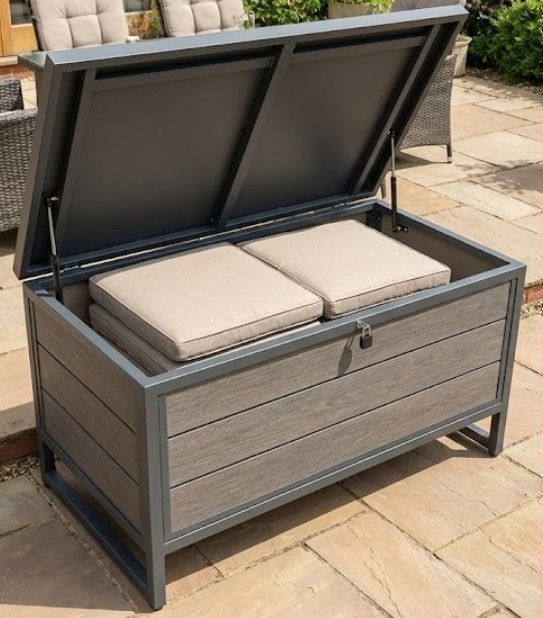
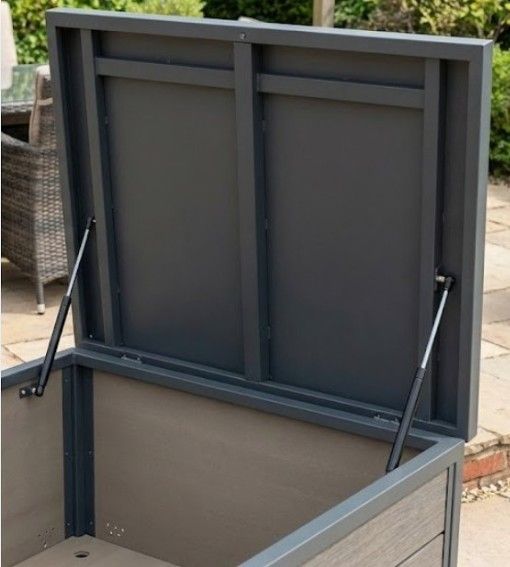
Gas struts assist lid opening on larger boxes, preventing lids slamming shut and making heavy lids manageable for all household members. This feature proves particularly valuable for boxes storing bulky but lightweight items like cushions – the lid and frame might weigh 30kg whilst stored contents weigh only 10kg, making unassisted lids difficult to control. Gas struts provide controlled opening and closing regardless of stored contents.
Lid design affects both weatherproofing and usability. Flat lids with minimal overhang create clean contemporary lines but require precise sealing to prevent rain ingress. Pitched or curved lids shed water more effectively and allow small overhangs that direct runoff away from box edges, improving weatherproofing whilst adding traditional storage box aesthetics.
Front-Opening Storage Boxes
Front-opening designs using doors or drop-down panels suit storage requiring frequent access without lifting heavy lids. These configurations work particularly well for tool storage or equipment accessed regularly during gardening seasons, and prove especially effective where storage boxes sit against walls or under overhangs where top access would be obstructed.
Drop-down front panels supported by chains or gas struts create convenient loading platforms – the panel swings down and holds position allowing items to be placed on it during loading, then lifts back to close position. This proves more comfortable than reaching deep into top-opening boxes, particularly for elderly users or when storing heavy items like power tools or bags of compost.
Doors on side-hinged boxes provide walk-up access similar to small sheds, though requiring adequate clearance for door swing. These designs suit larger storage boxes essentially functioning as compact garden buildings, often incorporating internal shelving or hooks for organised equipment storage.
Bench Storage Boxes
Dual-purpose storage boxes incorporating seating tops maximise functionality in gardens where space is premium. These designs combine weatherproof storage beneath with comfortable seating above, creating garden furniture that also solves storage needs. We fabricate bench storage in dimensions coordinating with existing garden furniture, using matching timber or composite materials for visual cohesion.
Bench storage typically uses lift-lid access, with the seating surface forming the storage box lid. Robust hinges and properly sized gas struts ensure lids support adult weight when closed whilst remaining manageable to open. Seating surfaces require different engineering than simple lids – adequate strength to support users without flexing, comfortable width (minimum 400mm), and appropriate height (typically 0115 647 6611mm) for comfortable seating.
These designs prove particularly effective on patios and decking where furniture is wanted but storage also needed. A bench storage box can replace a standard garden bench whilst adding 500+ litres of protected storage capacity, eliminating the need for separate furniture and storage boxes consuming limited outdoor space.
Material Options and Construction
Metal Framework with Timber Panels
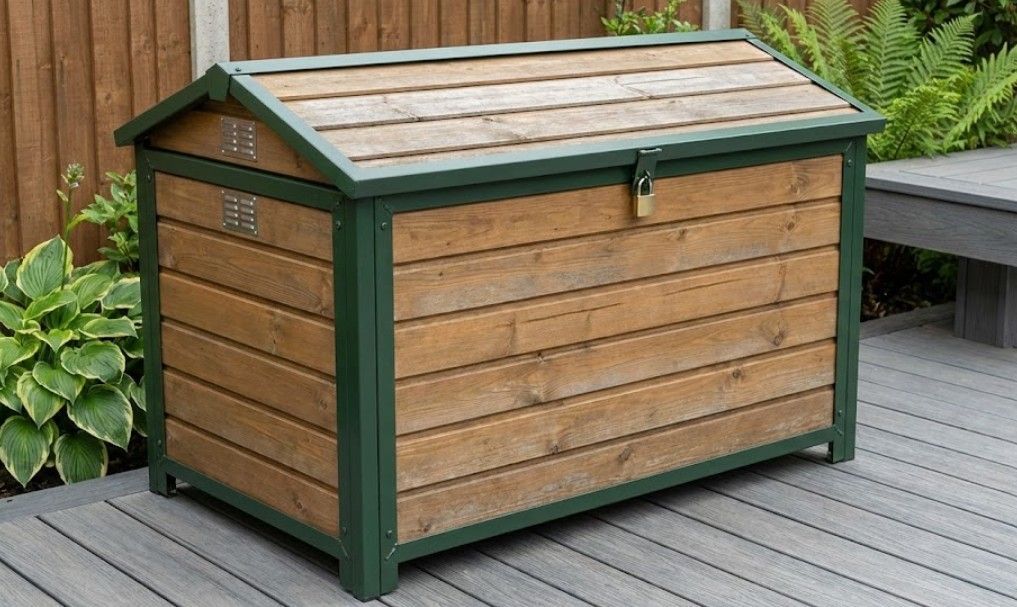
Steel framework combined with timber panel cladding creates storage boxes that complement traditional garden settings whilst delivering structural integrity and security plastic boxes cannot match. The framework provides robust corner posts and base structure, whilst timber panels form sides, ends, and lids matching existing garden furniture, decking, or fencing.
Timber offers natural aesthetics and can be oriented horizontally or vertically depending on your preference. Tongue-and-groove boarding creates attractive traditional appearance with inherent weather resistance through overlapping profiles. Ship-lap or feather-edge boarding provides alternative styling whilst maintaining good weatherproofing through overlapping construction.
We typically use pressure-treated softwood for economy or hardwood species (iroko, oak, or teak) for enhanced durability and richer appearance. Timber requires periodic treatment – usually annually – with appropriate wood preservers or oils, but this maintenance burden remains modest compared to the aesthetic benefits and how naturally timber storage integrates into garden settings.
Metal Framework with Composite Panels
Composite materials – wood-plastic composites combining wood fibres with polymer resins – eliminate maintenance requirements whilst providing wood-like appearance. These panels resist moisture, won't rot or split, and maintain appearance despite prolonged weather exposure without requiring annual treatment that timber demands.
For storage boxes that might receive minimal maintenance attention, composite panels prove particularly effective. The consistent appearance – composites don't weather to grey like untreated timber or require regular staining to maintain colour – means storage boxes continue looking professional year after year with virtually no attention beyond occasional hosing down.
Composite materials cost more initially than timber but often prove more economical over storage box lifespans of 20+ years. The eliminated maintenance burden particularly matters for storage boxes, which unlike garden furniture used regularly receive less frequent attention and might sit neglected until stored contents are needed.
Powder-Coated Steel Construction
All-metal storage boxes using powder-coated steel panels provide maximum security and durability, particularly appropriate where vandalism concerns exist or where storage contents have significant value. Steel panels create fully weatherproof enclosures resistant to forced entry, whilst powder coating in colours matching property exteriors or existing structures helps substantial metal boxes integrate visually despite robust construction.
Metal construction suits locations where traditional aesthetics matter less than security and longevity – poolside storage for equipment and chemicals, commercial premises storing valuable tools or machinery, or locations where previous storage has suffered theft or vandalism. These designs prove essentially indestructible under normal use, requiring no maintenance beyond periodic cleaning and occasional touch-up of scratched powder coating.
Ventilation remains important even with metal construction – we incorporate ventilation grilles or louvred panels maintaining airflow whilst preserving security and weatherproofing. This prevents condensation forming inside sealed metal boxes when temperature drops overnight, which can damage stored contents despite excellent rain protection.
Sizing Storage for Different Applications
Cushion and Textile Storage
Garden furniture cushions require storage protecting them from weather whilst allowing adequate air circulation preventing mildew during storage. A standard three-seater sofa cushion set (seat cushions plus back cushions) typically requires approximately 1200mm × 600mm × 600mm storage capacity, though exact requirements vary by cushion thickness and whether they're stored folded or flat.
Parasol canopies, outdoor rugs, and throw cushions add to storage requirements. A comprehensive cushion storage box for typical patio furniture (table, four chairs, parasol) typically measures 0115 647 6611mm long × 0115 647 6611mm deep × 700mm high, providing adequate capacity without excessive bulk. Storing cushions upright on edge rather than stacked flat reduces required box height whilst maintaining adequate capacity.
Internal dividers help organise different cushion types – separating seat cushions from back cushions, or segregating parasol components from soft furnishings. This organisation makes locating specific items straightforward rather than requiring complete unpacking to find individual cushions.
Tool and Equipment Storage
Garden tools, power equipment, and maintenance supplies benefit from organised weatherproof storage keeping them protected yet accessible. A basic tool storage box accommodating common hand tools (spades, forks, rakes, hoes) plus smaller items requires approximately 1000mm × 500mm × 600mm, though power tools and larger equipment like hedge trimmers or leaf blowers increase size requirements substantially.
Internal shelving or hooks maintain organisation – hanging tools on internal wall-mounted hooks prevents tangled handles and makes locating specific tools straightforward. Shelving accommodates smaller items like hand trowels, secateurs, and garden twine whilst keeping them visible and accessible rather than buried at box bottoms under larger tools.
For storage accommodating ride-on mowers, rotary mowers, or substantial equipment, dimensions might reach 2000mm × 1000mm × 1000mm or larger. These substantial boxes essentially function as compact equipment sheds, often incorporating front-opening rather than top-opening access given the depth and weight of stored equipment.
Pool and Spa Equipment Storage
Swimming pools and hot tubs require storage for maintenance equipment, chemicals, cleaning tools, and accessories. These items need particularly secure storage given chemical hazards and equipment values. Storage boxes positioned poolside require marine-grade construction resisting chlorine exposure and constant humidity.
Typical pool storage boxes measure 0115 647 6611mm × 0115 647 6611mm × 0115 647 6611mm, accommodating pool vacuum equipment, chemical containers, testing kits, and cleaning accessories. Internal shelving helps organise different item types whilst keeping chemicals elevated away from box bottoms where any water ingress might collect.
Ventilation proves especially important for pool storage given chemicals stored. Adequate airflow prevents fume accumulation from chlorine or other chemicals, whilst also allowing wet pool toys or equipment to dry rather than promoting mould growth inside enclosed storage.
Barbecue and Outdoor Cooking Storage
Barbecue covers, tools, fuel, and cooking accessories benefit from dedicated weatherproof storage near outdoor cooking areas. A storage box for typical gas barbecue accessories (tools, spare gas cylinders, covers, cleaning equipment) requires approximately 1000mm × 600mm × 600mm, positioned conveniently near the barbecue itself.
Gas cylinder storage requires particular attention to ventilation and safety – cylinders must never be stored in completely sealed enclosures where leaked gas might accumulate. We design barbecue storage with substantial ventilation grilles low on side panels, allowing heavier-than-air propane to dissipate safely if leaks occur.
Combining storage with preparation space proves popular – storage box tops sized at appropriate working height (approximately 900mm) create convenient surfaces for food preparation or plating during outdoor cooking, effectively providing both storage solution and additional workspace around barbecue areas.
Weather Protection Engineering
Lid Sealing and Water Shedding
Effective weatherproofing requires both preventing water entry and managing any water that does penetrate. We design lids with overlapping edges that direct water outward away from box bodies, creating the first line of defence against rain ingress. Properly sized overhangs (typically 30-50mm beyond box body) ensure rain doesn't run down box sides but sheds clear.
Sealing strips along lid edges provide secondary weatherproofing once overlapping design has directed most water away. We use closed-cell foam strips that compress when lids close but recover fully when opened, maintaining effective sealing despite thousands of open/close cycles over years of use. These seals install in recessed grooves rather than surface-mounting, protecting them from UV degradation and accidental damage.
Pitched or crowned lids shed water more effectively than flat designs and prove particularly important for larger storage boxes where flat lids might pond water in centres despite adequate drainage at edges. Even subtle pitches (5-10° slope) significantly improve water shedding compared to completely flat designs.
Drainage and Ventilation
Despite best weatherproofing efforts, some moisture inevitably enters storage boxes – carried in on damp stored items, condensing from humid air when temperatures drop, or occasionally penetrating through seals during severe weather. Adequate drainage allows this moisture to escape rather than accumulating.
We incorporate drainage holes or slots low on box sides, positioned where they won't allow rain ingress but will drain any internal water accumulation. These typically measure 10-15mm diameter, adequate for drainage whilst being too small for mice or insects to enter. Positioning multiple small drainage points around box perimeters proves more effective than single large drains.
Ventilation separate from drainage prevents condensation forming inside sealed boxes. Small ventilation grilles positioned high on end panels allow air circulation whilst being positioned too high for rain to enter directly. This air movement prevents the humidity buildup that causes condensation when temperatures fall overnight, keeping stored contents genuinely dry rather than merely protected from direct rain.
Base Design and Ground Contact
Elevating storage box bases above ground level prevents prolonged ground contact that accelerates framework corrosion and creates damp storage conditions. We typically design storage boxes with 0115 647 6611mm ground clearance using framework legs or plinths, allowing air circulation beneath whilst keeping box bases clear of standing water after heavy rain.
This elevation also makes storage boxes easier to keep clean – sweeping or hosing beneath becomes straightforward rather than impossible, preventing the debris and vegetation buildup that occurs with ground-contact storage. The airflow beneath also helps boxes dry quickly if rain has driven under lids during severe weather.
For storage boxes positioned on grass rather than hard surfaces, we can incorporate larger plinths or base frames that distribute weight preventing boxes sinking into soft ground. These bases also create barriers preventing grass growing up against box sides, which would hold moisture against framework and panels accelerating deterioration.
Security Features for Different Applications
Domestic Storage Security
Residential storage boxes typically require security deterring opportunistic theft whilst remaining convenient for legitimate use. Padlock hasps allow securing boxes overnight or during holidays without complicating daily access during gardening season. Heavy-duty hasps resist bolt cutters better than standard hardware, justifying modest additional cost where stored contents have value.
Internal locking mechanisms that engage automatically when lids close prove convenient for frequently accessed storage – the box locks when shut requiring key or combination to reopen, but locking happens automatically without requiring deliberate padlock application. These systems suit storage accessed multiple times daily where repeatedly applying padlocks becomes tedious.
Positioning storage boxes within fenced gardens or areas with natural surveillance provides security beyond physical locking mechanisms. Storage visible from property windows or in locations requiring trespassers to expose themselves to observation risks deters opportunistic theft more effectively than purely relying on locks.
Commercial and High-Value Storage
Commercial premises, pool facilities, or storage for valuable equipment requires robust security resisting determined theft attempts. Heavy-duty construction with reinforced lid frameworks, concealed hinges preventing removal, and commercial-grade locking systems provide baseline security appropriate for these applications.
Multiple locking points around lid perimeters prevent forcing lids open despite locks being secure – attempting to pry open one side of a multiply-locked lid proves far more difficult than breaching single-point locking. We position locking points strategically around perimeters making forced entry require attacking multiple locations rather than concentrating effort on single weak points.
Some commercial storage requires audit trails showing when boxes were accessed. Electronic locking systems with keypad or proximity card access log entry times and user identities, allowing organisations to monitor usage patterns and investigate incidents if problems occur. These systems suit organisations where multiple staff access storage and traditional key distribution becomes unmanageable.
Child Safety Considerations
Storage boxes accessible to young children require safety features preventing entrapment if children climb inside during play. We incorporate ventilation adequate to prevent suffocation risks, lid mechanisms that can be opened from inside (push-up latches or simply hinges without external locks), and gas struts that prevent lids slamming if released quickly.
For storage containing hazardous materials – pool chemicals, pesticides, or fuel – lockable designs preventing child access prove essential. These situations require balancing security against adult access convenience, often solved through combination locks eliminating key management whilst providing adequate security against young children.
Rounded corners and edges without sharp projections reduce injury risks if children play around storage boxes. Whilst storage boxes aren't playground equipment, recognising that children will inevitably climb on them and designing accordingly reduces accident risks without compromising storage functionality.
Integration with Garden Design
Coordinating with Outdoor Furniture
Storage boxes often sit alongside garden furniture, making visual coordination important for cohesive outdoor spaces. Using matching timber species and finishes creates intentional appearance – storage boxes appearing as purposeful additions rather than afterthought clutter. Where garden tables use iroko timber, specifying matching iroko for storage box panels creates visual harmony.
Powder coating colours matching existing metalwork ties storage into broader design schemes. Storage boxes using same framework colours as gates, railings, or furniture frames demonstrate attention to detail that elevates overall garden aesthetics. This coordination proves particularly important for visible storage – boxes positioned on patios or near main garden access routes.
Some designs incorporate storage directly into furniture – bench storage combining seating with storage beneath, or planter boxes with storage compartments integrated below planting areas. These multifunctional designs prove especially effective in smaller gardens where every element needs justifying its footprint through multiple purposes.
Matching Architectural Character
Storage boxes positioned near properties benefit from coordination with architectural character. Traditional properties suit storage using natural timber with pitched lids echoing building roof lines, whilst contemporary architecture pairs well with clean-lined metal or composite designs with minimal detailing.
Colour selection significantly affects integration – storage boxes matching property trim colours (window frames, doors, or architectural details) appear intentional rather than generic additions. In conservation areas or with listed buildings, this coordination often proves essential for planning approval even when storage technically falls within permitted development.
Scale and proportion matter equally – oversized storage boxes dwarf small gardens regardless of material quality, whilst undersized boxes look temporary and inadequate even when well-constructed. We discuss appropriate sizing considering both storage requirements and visual impact, ensuring boxes function adequately without dominating gardens unnecessarily.
Maintenance and Long-Term Care
Framework Care
Powder-coated steel frameworks require minimal attention beyond periodic inspection and cleaning. Annual inspection checking for coating damage – particularly around ground-level components, lid hinges, and high-wear areas around locks – allows addressing minor issues before developing into corrosion problems. Touch-up paint maintains coating integrity if scratches or chips are noticed.
Keeping framework clear of vegetation and soil buildup prevents moisture being held against powder coating causing premature paint failure. Plants growing against box sides or leaves accumulating around bases should be cleared periodically – this simple maintenance takes minutes but significantly extends framework life.
Bolt connections should be checked annually, retightening any loosened through thermal cycling or vibration. This maintains structural integrity and prevents rattles developing. Stainless steel hardware rarely requires replacement, but standard steel fixings may eventually corrode in exposed locations and benefit from proactive replacement before failure.
Panel Maintenance
Timber panels benefit from annual treatment with appropriate wood preservers, oils, or stains maintaining protection against rot and weather damage. This treatment proves especially important for panel bases near ground level where moisture exposure is greatest. Regular treatment prevents the wood rot that eventually requires complete panel replacement if neglected.
Composite panels require virtually no maintenance beyond occasional hosing down removing accumulated dirt and algae. Unlike timber, composites don't require staining or sealing, making them ideal for storage boxes receiving minimal attention. Any surface mould or algae washes off with standard outdoor cleaner or dilute bleach solution.
Metal panels need inspecting for coating damage – scratches exposing bare steel should receive touch-up paint preventing rust developing. Any rust that does appear should be addressed promptly by removing rust, treating with appropriate primer, and repainting rather than allowing corrosion to spread.
Moving Parts and Hardware
Hinges, gas struts, and locks require periodic lubrication maintaining smooth operation. Annual lubrication prevents seizure and ensures lids continue opening easily despite regular use and weather exposure. Graphite-based lubricants work well for locks, whilst general-purpose grease suits hinges and mechanical components.
Gas struts gradually lose pressure over years, becoming less effective at supporting lid weight. When lids begin closing too quickly or require excessive effort to open, gas strut replacement restores proper operation. We can supply replacement struts with specifications matching original installation, making replacement straightforward for competent DIY users or we can perform replacements during maintenance visits.
Locks exposed to weather benefit from periodic cleaning removing salt and grime that can cause internal mechanism problems. Covering locks when not in use – using flip covers or similar – extends lock life significantly. Where locks become difficult to operate, cleaning and lubrication usually restores function without requiring replacement.
Seal Maintenance
Weatherproofing seals around lids gradually compress and degrade with age and UV exposure. Inspecting seals annually and replacing when they no longer compress adequately or show cracking maintains weatherproofing effectiveness. Replacement seals install in existing grooves using adhesive backing, making replacement straightforward.
Where storage boxes develop water ingress despite apparently adequate sealing, checking drainage holes remains open ensures any water that does enter can escape. Blocked drainage – leaf debris, spider webs, or paint from refinishing – should be cleared periodically. Flushing drainage holes with water occasionally confirms they remain functional.
Commissioning Process and Installation
Design Consultation and Space Planning
Creating effective outdoor storage begins with understanding what you're storing, where storage will be positioned, and any constraints affecting design. Site visits allow us to measure available space accurately, assess ground conditions, understand sun exposure and weather patterns affecting the location, and identify factors influencing design decisions.
We discuss priorities – weather protection versus easy access, security requirements versus maintenance preferences, integration with existing features versus standalone functionality. This conversation ensures storage boxes we fabricate genuinely address your needs rather than theoretical ideal designs that prove impractical in your specific circumstances.
Showing sample materials – timber species, composite finishes, powder coating colours – helps with specification decisions. Photographs can mislead, but seeing and touching actual materials allows informed choices about appearance and appropriateness for your property and preferences.
Fabrication Timeline and Process
Typical outdoor storage boxes require 4-6 weeks from confirmed order to installation. This lead time covers framework fabrication, powder coating, preparing and finishing panel materials, hardware procurement, and scheduling installation. Simple designs sometimes complete faster when workshop capacity allows, whilst complex boxes with extensive internal fittings or unusual specifications may require 8+ weeks.
We provide detailed quotations itemising framework, panels, lids, gas struts where applicable, locks and hardware, and installation including any ground preparation. Whilst bespoke storage costs more than mass-produced alternatives, proper engineering delivers decades of service – we regularly maintain and refurbish storage boxes we fabricated 15+ years ago, whilst cheap alternatives typically fail completely within 5-7 years requiring total replacement.
Progress updates during fabrication allow addressing any questions or concerns before completion. We photograph storage boxes during assembly allowing you to see construction quality and confirm specifications match expectations before delivery and installation occurs.
Installation and Ground Preparation
Storage boxes require level stable bases for proper operation and longevity. Lids on boxes positioned on uneven ground bind or refuse to close properly, drainage doesn't function correctly, and frameworks experience uneven stress causing premature failure. We assess ground conditions during site visits, recommending preparation appropriate to your specific location.
Existing hard surfaces – patios, decking, or paving – usually accommodate storage boxes directly though levelling might be required. Installations on grass or soil benefit from preparatory groundwork – laying paving slabs or concrete pads creates stable level surfaces whilst preventing boxes sinking into soft ground over time and keeping storage areas clean rather than muddy.
Installation typically takes half a day for straightforward designs, longer for large boxes or where substantial ground preparation is required. We ensure lids operate smoothly, that gas struts function correctly through full opening range, and that any drainage or ventilation features work as designed. Testing locks and explaining any maintenance requirements completes the installation process.
Contact Nottingham Metalworks to discuss bespoke outdoor storage boxes for your property. We provide detailed quotations following site visits, ensuring storage solutions sized precisely for your requirements, appropriate to your space, and coordinated with existing garden features.
