Steel Trusses Nottingham
Roof Trusses, Structural Trusses, Lattice Girders & Long-Span Solutions
Steel Truss Fabrication
Nottingham Metalworks fabricates steel roof trusses for commercial, industrial, and agricultural buildings across Nottingham and Nottinghamshire. From parallel chord trusses and pitched roof trusses to bowstring trusses and lattice girders, we deliver engineered structural steel truss solutions meeting BS EN 1090 standards with precision fabrication and professional installation.
Engineered Steel Truss Solutions
Steel trusses provide efficient structural solutions for spanning large distances whilst minimising material usage and structural weight. The triangulated geometry of trusses—connecting top and bottom chords with diagonal and vertical web members—distributes loads effectively, achieving spans impractical with simple beam construction. Trusses suit warehouses, industrial facilities, agricultural buildings, sports halls, retail sheds, and any structure requiring clear-span coverage.
At Nottingham Metalworks, we specialise in fabricating steel roof trusses and structural trusses for building projects across Nottingham and Nottinghamshire. Our truss fabrication covers parallel chord trusses for flat and low-pitched roofs, pitched trusses replicating traditional roof profiles, bowstring trusses creating curved roof lines, and lattice girders for heavy-duty structural applications. Every truss is fabricated to BS EN 1090 structural steelwork standards, ensuring regulatory compliance and structural integrity.
Steel trusses achieve remarkable spans—commonly 15-30 metres for roof applications, with specialist designs exceeding 40+ metres. This spanning capability eliminates internal columns, maximising usable floor space for storage, manufacturing, agricultural operations, or sports activities. The geometric efficiency of trusses means structural depth (truss height) is typically only 1/10 to 1/15 of the span, providing height without excessive structural intrusion.
We work with structural engineers, architects, contractors, developers, and building owners across diverse applications—warehousing and logistics, manufacturing and industrial processing, agricultural buildings and storage, retail and commercial developments, and sports and leisure facilities. Our truss fabrication integrates with modern construction methods, supporting fast-track building programmes and economical structural solutions.
The versatility of steel trusses extends beyond simple roof structures. Transfer trusses support building loads across large openings. Floor trusses create long-span floors for mezzanines or specialist applications. Façade trusses provide structural support for building envelopes. Whatever the application, steel trusses deliver proven structural performance with established design methodologies and reliable construction.
TYPES OF STEEL TRUSSES
Roof Truss Configurations
Parallel Chord Trusses
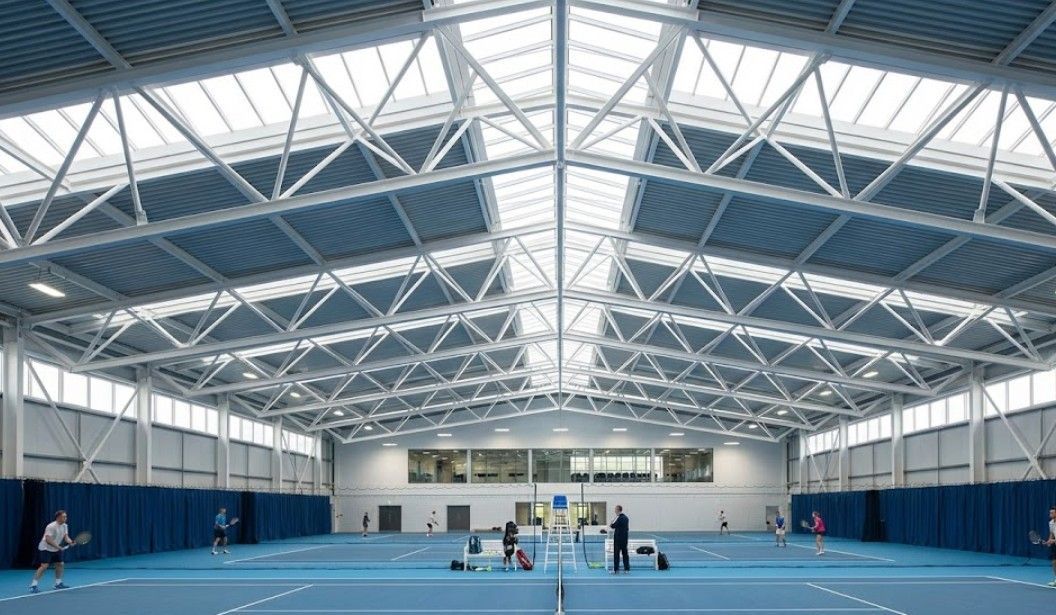
Parallel chord trusses feature horizontal top and bottom chords with web members connecting them in diagonal patterns. The uniform depth along the truss length suits flat roofs or very low-pitched roofs where visual impact of varying depth would be problematic. We fabricate parallel chord trusses for warehouse and distribution centre roofs, industrial building roof structures, retail shed covering, and sports hall roofing. Web configurations vary—Warren trusses use diagonal members only, Pratt trusses combine verticals and diagonals for specific loading patterns, and N-trusses or K-trusses provide increased web density for heavy loading. Typical depths range from 0115 647 6611 metres for commercial applications.
Pitched Roof Trusses
Pitched trusses create traditional triangular roof profiles with sloping top chords meeting at a central apex. The varying depth (shallow at eaves, deep at ridge) efficiently resists loading patterns typical of pitched roofs. We fabricate Fink trusses (W-shaped web configuration), Howe trusses (vertical and diagonal webs), fan trusses (radiating web pattern from apex), and custom pitch trusses for specific architectural requirements. Pitched trusses suit applications where roof pitch is required for drainage, snow shedding, architectural aesthetics, or accommodating services within truss depth.
Bowstring Trusses
Bowstring (or arched) trusses feature curved top chords creating graceful roof profiles whilst maintaining straight bottom chords. The arch geometry provides structural efficiency and attractive aesthetics. We fabricate bowstring trusses for agricultural buildings wanting curved roof profiles, sports facilities creating impressive internal volumes, leisure centres and swimming pools, and commercial buildings where architectural impact matters. The curved top chord can be fabricated from curved steel sections or approximated using straight segments welded at angles—your structural engineer specifies appropriate construction based on span and architectural requirements.
Lattice Girders & Heavy-Duty Trusses
Large-span or heavily-loaded applications require substantial lattice girders combining truss principles with robust member sizing. We fabricate transfer trusses supporting building loads across large openings, bridge trusses for pedestrian or light vehicle crossings, crane gantry trusses supporting overhead travelling cranes, and structural trusses for specialist applications. Lattice girders use heavier chord sections (often fabricated plate girders rather than standard sections) with substantial web members accommodating significant loads.
TRUSS FABRICATION & ENGINEERING
Precision Truss Manufacturing
Design & Engineering Coordination
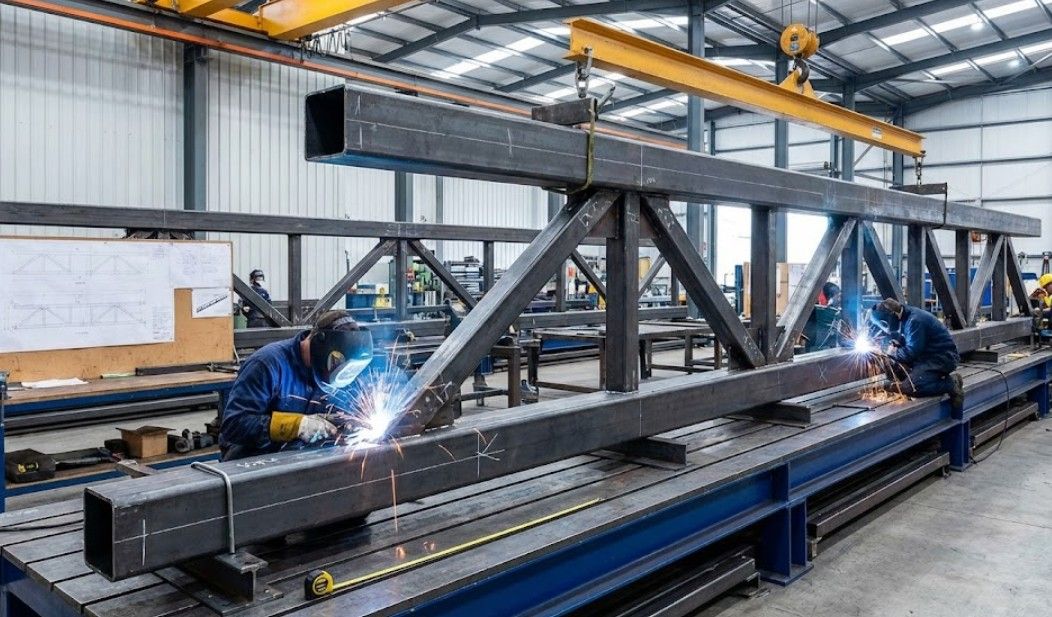
Steel truss fabrication begins with structural engineer's calculations and drawings specifying truss geometry, member sizes, connection types, and loading. We review truss designs identifying any fabrication considerations, coordinate with engineers where clarification is needed, and develop detailed workshop fabrication drawings showing exact member lengths, connection details, gusset plate dimensions, and assembly sequences. Truss geometry must be precise—triangulated structures amplify small errors, so fabrication accuracy is essential.
Member Preparation
Truss chord members (top and bottom) are cut to exact lengths accounting for connection geometries. Web members are cut with precise angles at each end—even small angular errors accumulate across multiple web members, affecting overall truss geometry. All cutting accounts for connection methods: members receiving gusset plates are cut square, directly welded connections are cut to specific angles, and bolted connections are drilled accurately for bolt hole patterns.
Truss Assembly
Trusses are assembled on fabrication jigs ensuring geometric accuracy. Bottom chord is positioned and secured, web members are fitted at specified angles and spacings, top chord is positioned completing the triangulated geometry, and all joints are checked for accuracy before welding or bolting. Fabrication jigs maintain truss geometry during welding, preventing distortion from welding heat. Large trusses may be fabricated in sections, joined during installation or before delivery depending on transportation constraints.
Connection Methods
Truss connections use gusset plates (steel plates connecting multiple members at nodes), direct member-to-member welding for simpler geometries, or bolted connections where site assembly is required. Connection design balances structural efficiency, fabrication practicality, and erection requirements. All welding follows BS EN 1090 procedures with appropriate weld sizes and quality levels. Gusset plates are carefully sized and positioned ensuring load paths through connections are efficient.
Surface Protection
Fabricated trusses receive blast cleaning and protective primer coating. Agricultural buildings or corrosive environments may specify hot-dip galvanizing. Fire protection requirements determine whether intumescent coatings are needed. We coordinate finishing during fabrication, ensuring trusses arrive on site appropriately protected for their service environment.
TRUSS INSTALLATION
Professional Truss Erection Services
Steel truss installation requires careful planning, appropriate lifting equipment, and experienced erection teams. Our installation partners processes ensure safe, efficient truss erection coordinated with building construction.
Pre-Installation Planning
Truss erection planning addresses crane requirements and positioning, lifting point locations on trusses, erection sequence minimising temporary works, temporary bracing requirements, and weather monitoring (wind limits crane operations). We develop method statements and risk assessments addressing working at height, crane operations, and site coordination.
Truss Lifting & Positioning
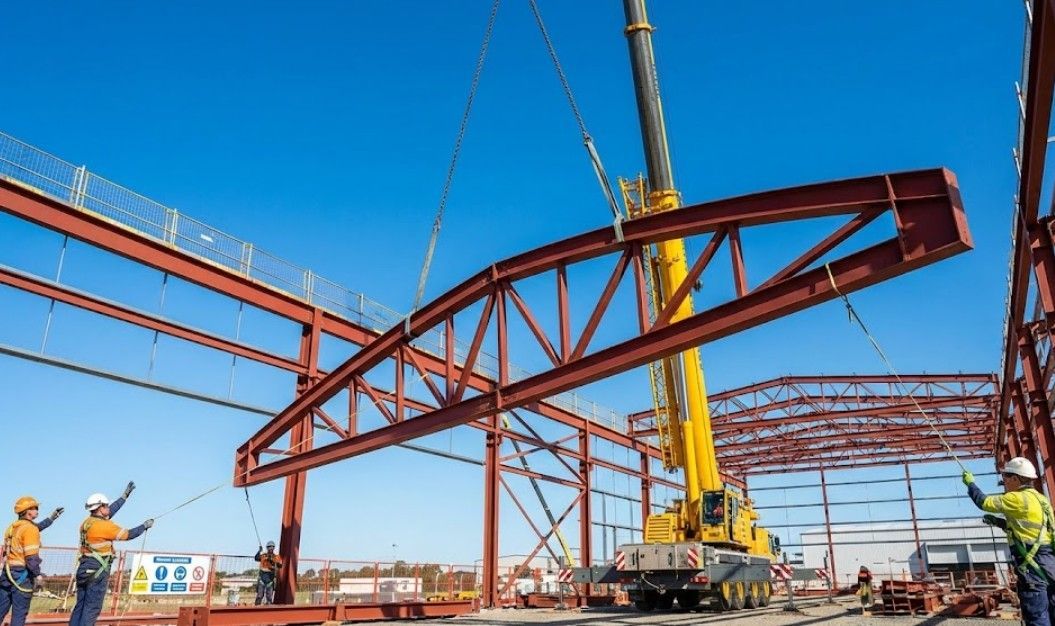
Mobile cranes lift trusses from horizontal positions, rotating them during lifting. Trusses are positioned onto bearing plates or supporting structures with steel erectors guiding trusses using tag lines. Accurate positioning is critical—trusses must bear correctly on supports, alignment must be maintained for purlins and bracing, and verticality ensures proper load transfer. Temporary bracing stabilises trusses until permanent bracing and purlins are installed.
Secondary Steelwork
Once trusses are erected and braced, purlins span across top chords supporting roof cladding, bottom chord bracing provides lateral stability, and rafter stays or sway bracing ensure structural stability. Secondary steelwork completes the roof structure, ready for cladding contractors.
Quality Assurance
Completed truss installations undergo verification checking dimensional accuracy, connection integrity, and overall stability before handover to following trades.
APPLICATIONS & ADVANTAGES
Why Specify Steel Trusses
Steel trusses excel where long spans, minimal structural depth, and economical construction are priorities. Agricultural buildings achieve wide clear spans accommodating modern machinery and storage. Warehouses maximise cubic storage volume without columns. Sports facilities create unobstructed playing spaces. Industrial buildings provide flexible manufacturing areas.
The economic efficiency of trusses—using less material than equivalent beam construction—reduces both material costs and foundation loads. Off-site fabrication ensures quality and accelerates site programmes. And proven structural performance provides confidence in long-term reliability.
COMMISSIONING STEEL TRUSSES
Starting Your Truss Project
Commissioning steel trusses begins with discussing building requirements—span needed, roof profile desired, loading conditions, and any architectural considerations. We coordinate with structural engineers developing economical truss solutions, or fabricate to your engineer's designs.
We provide detailed quotations covering truss design coordination if required, workshop fabrication with precision assembly, protective coatings appropriate to environment, delivery coordinated with construction programme, and professional erection and installation. Typical fabrication requires 12 weeks from approved drawings, with installation taking 4-5 days depending on building size.
Steel Trusses in Nottingham
Ready to discuss your steel truss requirements?
Call: 0115 647 6611
Serving Nottingham, Nottinghamshire, and the East Midlands. Steel roof trusses for commercial, industrial, and agricultural buildings. Explore our structural steel services including building frames.
